Showing posts with label art. Show all posts

"Utopia and an Accident"

This post was updated on 1/3/2017.
Sometimes, the mind needs a holiday - especially from all it is conditioned to think and expect. Such a holiday was the effect of happening on an artist's website this evening, purely "by accident". (I was googling the phrase "poetry does not lead to" - interesting exercise, but perhaps best saved for another post.) The installment on the artist's website I was led to on my search seeks "a sculptural excuse where poetry does not lead to evident facts".
What caught my attention were two things: the title of the installment: "The New Sincerity", and the phrase describing the work: "intersection between utopia and an accident or improvised event".
And here is where my mind went: the title makes sense because while sincerity is timeless, it must be forged anew given the ever-changing customs and now technologies mediating it. My second idea was about how the tension in the juxtaposition between utopia and accident/improvisation is almost like a riddle.
It reminded me of my favourite passage by H. Randall about Plato's utopia (in "Plato's Treatment of the Good Life and His Criticism of the Spartican Ideal"), where he explains how utopia is to be understood: as a general direction, not a final destination:
There is the constant temptation to live in the vision, rather than by the vision: to want to go to Heaven, like the Christians, or to bring Heaven here to America like the moderns, instead of living well a human life with vision. There is the temptation to demand perfection, and to condemn all existence because it falls short of what it might be, as it naturally must, instead of using the vision of perfection to discriminate between what is better and what is worse in our relatively and inevitably imperfect world... This, it may be, is the truth that lies behind Plato's ironical warning that the effect of poets is often bad: because men are apt to be too stupid to realise that they are poets, and to take them literally, instead of seriously.

The artist, Belén Rodriguez Gonzales, from the video summing up her work, seems to demonstrate, through things, this problem between projected grids and a geographical, cosmological freeplay of motion: winds, the effects of the sea, the shining of the sun... Despite the grids (or, the "literal"), there is a lot of apparent "potential for vision" for one who is looking. The challenge of life is to learn how to make something of the "natural musts" without losing poetic vision.
Speaking of the poetic, I had been uncertain about what Belén meant by the phrase "a sculptural excuse where poetry does not lead to evident facts", and have since had the great pleasure of corresponding with her in order to clarify. I admit that I had initially understood it to be deliberately opaque in the language of much post-formalist art, but could not have been farther from the truth. Her art is, in part, a response to the overload of art that fades once the joke is over.
Belén's art is like the poeisis that Huizinga describes in Homo Ludens: it is not bound by the ties of the everyday and is inaccessible to the drill of the rational mind. In other words, it is ethereal and elusive, to be grasped at and pondered over, and, in that process, to become transformed (which is the result of all good dialectics).
Huizinga writes:
Poeisis, in fact, is a play-function. It proceeds within the play-ground of the mind, in a world of its own which the mind creates for it. There things have a very different physiognomy from the one they wear in ‘ordinary life’, and are bound by ties other than those of logic and causality. If a serious statement be defined as one that may be made in terms of waking life, poetry will never rise to the level of seriousness. It lies beyond seriousness, on that more primitive and original level where the child, the animal, the savage and the seer belong, in the region of dream, enchantment, ecstasy, laughter. To understand poetry we must be capable of donning the child’s soul like a magic cloak and of forsaking man’s wisdom for the child’s. 
I like the playfulness, general selection of ideas, and broader implication of Belén's art: it's one holiday for the mind. And if there's a moral to the story of this post, it's that chance can afford a scrap that can be turned into magical good fortune by one who is looking.
Brush: Misprinted Type.

Fire

In keeping with the August break, today's topic is fire. Accompanying text shall be selections from Johann Joachim Winckelmann, an inspiration to Walter Benjamin (and Lessing, Herder, Goethe and Kant). According to the The Classical Tradition, Winckelmann was influential on "late Enlightenment and early 19th century thought concerning the aesthetic and ethical ideals embodied in classical Greek culture". His History of the Art of Antiquity was once considered, though reworked, to be the fullest extant compendium on the subject, taking "the step to elaborate a speculative history that attempted to integrate the commentaries on the history of ancient Greek and Roman sculpture in the ancient literature with the existing material remains of this art excavated in Italy" (emphasis added, contributor Alex Potts notes the sparcity of archaeological evidence available then: Winckelmann gains through his enthusiasm what he loses in accuracy).
In the History of Ancient Art, Winckelmann writes that Persian religious service was not favourable to the arts as "the visible heavens and fire were the highest objects of their adoration" (314) - interesting to contemplate in a culture that expects ideals to be materialised.
In The History of Ancient Art Among the Greeks, he writes that "ancient artists" depicted the expression of passions such that it "always corresponds to what we should look for in a man of disciplined mind, who prevents his feelings from breaking forth, and lets only the sparks of the fire be seen; who seeks to penetrate the latent motives of him who comes to honor him, or to play the spy." (163) In this context, greatness of mind is represented as "noble simplicity" betraying neither frivolity nor craft but innocence and a "trustful nature". An interesting contrast to the jaded perhaps even corrupt hero of today.
Winckelmann compares beauty to essence extracted from matter by fire, "it seeks to beget unto itself a creature formed after the likeness of the first rational being designed in the mind of the Divinity" (ibid., 44). Were that all we wrote such an essential phoenix emerging from the flames.

Brush: pfefferminzchen paper via DeviantArt.

Basilisk

Charles M. Skinner writes that basil, thought by some in the ancient world to be a poison though by others to be a cure (egs.), is belived in India to be a token by which admittance to heaven is gained. He adds that the Greek goddess of poverty, Penia (who was seduced by a drunk god of resourcefulness, Porus, to create love, Eros, according to Socrates in Plato's Symposium, 203) was often depicted as holding a sprig of basil in her hand (I was unable to find even one image). The alternate meanings of the Greek word for basil range from much that is regal and columned halls to messengers. It is strange that a word with so many sumptuous connotations was, where it refers to the plant, associated with poverty, and could further indicate something lethal. The plant is said to have been cursed at. Skinner suggests that it may be related to the basilisk, "a fabulous creature that could kill with a look".
My favourite description of the basilisk in the (wikipedia) link above is Pliny the Elder's description of how the only way to kill it was by having a weasel fight it, itself dying "in this struggle of nature against its own self".
The oppositions involved in these associations and myths bring to mind a passage in Lewis Hyde's Trickster Makes This World about "The Lucky Find", wherein the person being struck by accident need not see it as chaos or even cosmos (thence the oppositions) so long as "craft" or "technical skill" is applied to the accident in a way that is fruitful (dumb luck leads to no change, and often to loss). "With smart luck, the mind is prepared for what it isn't prepared for. It has a kind of openness, holding its ideas lightly, and willing to have them exposed to impurity and the unintended." Like in the Socratic tale: resourceless Poverty gets the chance to bed Resource!
But writing all this suggests a certain kind of knowing that, while ostensibly had, goes missing in practice. It grates my nerves. Except when there's an accident needing help.


My absence from the blog was in part due to temporary burnout I experienced at the uncertainties of teaching higher ed. So much is unclear, there is more work, and budgets are being slashed, which is to say that some of us are keeping fingers crossed lest Penia get too close. But such a sentence deserves no pity, for many of us deliberately took pay cuts to work in education to begin with; what is yet another cutback, and should one not be smart enough to manage?
Here, I shall leap into fancy, be warned. I think it is only when between a rock and a hard place that one has the liberty to float about in high-falooting philosophy, which I am about to do. For example, I can now say, like a Stoic, perhaps I would like a holiday but what is a holiday compared with strolling the palace of the somewhat educated mind?
In penury (one hyperbolizes, for effect), the regal chambers of ideas become potent. In the Socratic tale, it is possible to conceive even if one is devoid of resources. It is a question of waiting, while calling on Endurance, Hope, Phantasy, etc., until circumstance leads to greener pastures and the relevance of different currencies. That's really the best I can do for this post and for myself at this time. I had wanted to write a post for some time now, but was given the final impetus by a post at Dancing Beastie ("Seasonal living in a Scottish Castle") about an August Break, according to which today's topic is Art.
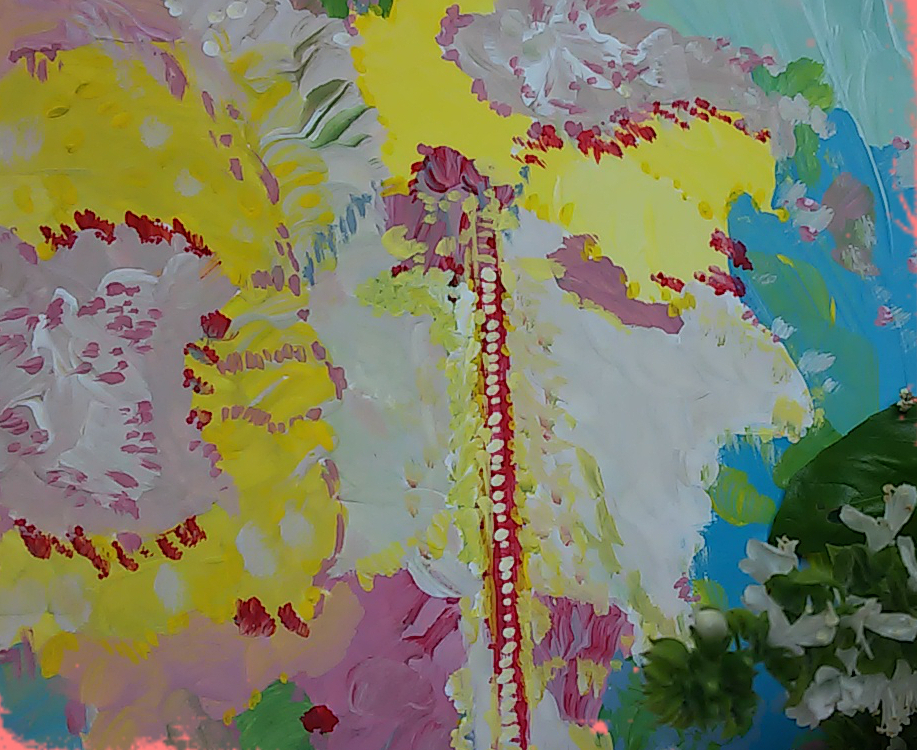
Below is part of a picture I recently painted, the first one in decades and before I figured out how to mix more nuanced colour, photographed in the wrong direction and accidentally, next to some basil.
 
Brush: Favourites by Egg9700 at DeviantART.

What Picture

One is not allowed to be a curmudgeon; life says to such an one, you are looking in all the wrong places. So it is that colour returns to life like to a face after initially blanching, there comes a blush. Though not that on a face in a little party dress but of one balking at the many inoculations one gets to this earthly life, perhaps one turned pale at the idea of drinking snake's blood, but then turned red again understanding that it was the only way to participate in that moment that was ultimately a gesture of good will made towards one's health.
 "If you suppose that only to be your own which is your own ... you will find fault with no one or accuse no one. ... say to every harsh appearance: 'You are but an appearance, and not absolutely the thing you appear to be.'"
It is funny to read Epictetus after papers on "learner autonomy" (wherein students are to take responsibility for their "learning experience"). It is funny because the essence of those early philosophical schools acknowledged this responsibility, hence the popularity of the maxims that were to help students remember and apply the philosophical tenets.
Learner autonomy, in its accountability, seems to move towards the Tao, wherein the sage merely demonstrates by example: while it is up to others to follow this example, it is posited that this is the only way to teach effectively because to impose ideals or morals, these can quickly become their opposite (Tao Te Ching 58). "The method of correction shall by a turn become a distortion, and the good in it shall by a turn become evil".
What is really at issue here is contained in the idiom (which is not the same thing as a cliché because of its economic, clear expression of a larger idea), practice what you preach. Epictetus would say, as does Lao Tzu, that one is to fulfill only one's part of the bargain and not worry about what other people owe, even if to do so means a loss, because this is how one is freed from grudges, which are not beneficial (80).


The practice of the better picture is stepping back to disengage from nets or nooses. Victory goes to the one who deplores war (69). "With that gentleness I can be bold; with that economy I can be liberal; shrinking from taking precedence of others, I can become a vessel of the highest honour. Now-a-days they give up gentleness and are all for being bold; economy, and are all for being liberal; the hindmost place, and seek only to be foremost;--(of all which the end is) death. Gentleness is sure to be victorious even in battle" (67).
Which reminds me of a short film I watched about Sister Corita Kent, of serigraphed Wonderbread and US Love stamp design fame, who said on leaving academia that the second part of one's life does not have to be the same as the first: and at that time she began to paint in lighter colours, in pastels. The film is a beautiful and colourful tribute of testimonies of that personality. We see a person who followed her gifts, even when this must have brought discomfort and existential questions; it is hard not to see the art as the answer that everything does turn out right if one follows one's path, it is perhaps the colour that does the convincing. "The groundwork doesn't show 'till one day" reads one of her serigraphs.
There is space for an ellipses, space formed by stepping back, a Socratic gap, like where he says in the Theaetetus that the beginning of learning is wonder or in Apology that wisdom is in knowing that one knows nothing, just like Lao Tzu writes "To know and yet think we do not know is one of the highest attainments". The opposite is a painful disease (71).
I think we create in the face of this disease, and death. Just like poet Kenneth Patchen wrote about how his injury, which kept him bedridden, spurred him to write, "for the sake of being able to show my sick part that it can never become all powerful".
In "What is the Beautiful?", Patchen writes, "Will the power of man flame as a sun? Will the power of man turn against death? Who is right? Is war? Pause. And begin again. A narrow line. Walking on the beautiful ground. A ledge of fire. It would take little to be free."
In one of Sister Kent's serigraphs, the Patchen line echoes, "Pause and begin again. It would take little to be free." Epictetus defines the free as that which is in our control. The picture is in learning where the canvas is, the aperture.


Magazine in background: Marie Claire Idees; bokeh brush by ~stock7000 at DeviantART.

Doubt into Yellow

Here is a photo of flowers taken two days after I bought them in the market from an old lady vendor on her little stool, whose shaky hands produced my change in notes pre-folded. There was such distillation in her existence, such premeditation and simplicity that I long to see in myself. I did not recognise the yellow flowers as snapdragons, and asked their name to learn the local appellation, "little yawners". There is a great distance between a yawn and a dragon's roar (assuming dragons roar). I found myself either roaring or yawning last week, it seems I have to watch out when people start talking about education, which I see as a craft and by no means a product. I hear I will be hired again this year, which is excellent considering that my PhD dissertation has fallen into an administrative black hole and as such is yet undefended. I need to know how how to greet what we are told to see as uncertain with the zen attitude of the surfer. I used to spend hours reading about surfers, like Laird Hamilton who was raised on waves so, naturally, I might think, sought big waves. Surfers don't tend to be big on words but to watch them is to see a difference in humanity: many take the plunge, but not with equal grace. Laird surfs effortlessly, in sprezzatura, little yawner with the force of a dragon.
There is a big wave before us; we are told it is big especially by the media. Where it is not bureaucratised, it is ruled by the relative values not of sophistication, like Feyerabend's defense of 1950's China's adoption of the Yellow Emperor's Textbook of Internal Medicine ("Acupuncture, moxibustion, pulse diagnosis have led to new insights, new methods of treatment, new problems both for the Western and for the Chinese physician"), but of musical chairs where the chair one had been sitting on may suddenly be removed in the next round, if it is the volition of the games' master to remove that particular one. Whether you are an artist, a teacher, an entrepreneur, you will hear about plenty of uncertainties.
After reading a useful post by Enbrethilel I wondered about how, frankly, we might need to be wiped out before the questionning of what a healthy mind takes for granted can begin, and the words can rally forth. Her post was specifically about education, and cites a book by John Taylor Gatto in which he identifies a problem of our age as beginning, "when the young were assigned to consume, not to produce". I will posit here that part of what it takes to create (poiesis) is doubt.
A recent NYRB article on Koons explains, "where there is no doubt, there is no art." It is doubt that reduces one to the epistemology of one's ontology. This can be explained by Taoism: I found a page that does this quite well (it gives the gist): "Certitude evolves forth to DOUBT as it answers, yet DOUBT revolves back to certitude as it QUESTIONS; hence, answer within the DOUBT, yet QUESTION within the certitude." In this equation, one is just to "realise" the extremes, flow, and potential balance.


Before the Taoist's five elements theory, symbolised in five colours (black, green, red, white, yellow), there were only the two colours of yin and yang: black and white. The "Yellow Emperor" mentioned above is not only said to be the ancestor of the Chinese, dating to the third millennium BC, but is an important deity in Taoism and it was his tribe that practiced what we take as typical Chinese medicines like acupuncture. He is also said to have helped create the first Chinese calendar and his wife was said to have discovered silk: no small discovery (need one even mention the silk road). His tribe honoured the yellow earth and Yellow River, and that colour, of the five, is that which symbolises a stabilising energy, associated with rice which grows in the yellow earth and brings stability to mankind. It is also important to feng shui, which is based on the five elements theory that roughly correspond to the cosmos.
I am focusing on yellow as it is the colour one hopefully comes to, it is the centre of the bagua, if you have ever seen that octagonal trigram template used in feng shui. It is a reminder that one is to seek the balancing force; e.g., in times of increased activity, to seek a restful attitude.
The skilled surfer does not wobble and is not too stiff. To quote a page on Taoism, "REST within the activity suggests that we will feel better in all life’s activities if we bring a RESTFUL attitude to activity, or as the Tao Te Ching puts it, blunt the sharpness; untangle the knots; soften the glare;… and so on." Such is one story of the yawning snapdragons.


Background: Marie Claire Idees; Brush: Ewansim flower grunge at DeviantART.

Stakes of Style

Self-contradiction in self.  It is possible to be hard-headed in some discussion and meek in others whether because of that sorry excuse called mood; a lapse of certainty making information familiar seem brand new; exaggerated admiration of someone else.  One may take the lack of certainty and let it grow, thinking one's lacunae make one gentleyet be preceded by the reputation of being a dragon.  This type of paradox may be called being serious (which does not necessarily make one an able thinker).  Serious people who are also sensitive may have a recurring problem where doggedness conflicts with the flaws of a humanity felt too deeply to be cosmetic.
This earnestness, which is a pledge, true to the root of the word, for even when not realised it remains present as an outstanding debt, can be confusing because people less committed will seek to bury alive that part of the person through a stifling lackadaisicalness.
"Une pierre, aux passants demandant un soupir, Du naufrage des ans a sauvé leur mémoire; Une muse ignorante y grava leur histoire", writes Chateaubriand in his poem, "Les tombeaux champêtres" on the country graves of those unknown, the lives of whom are recorded by an ignorant muse, and yet may prompt passers by to seek new paths, of friendship, "Qui ne tourne la tête au bout de la carrière? L’homme qui va passer cherche un secours nouveau: Que la main d’un ami, que ses soins chers et tendres, Entrouvrent doucement la pierre du tombeau !"  It is the touch of friendship that lives beyond the grave. It is the word of friendship that can keep us alive when we are threatened by the stone of an ignorance greater than one's own, that of complacency.
But who would choose for the ignorant muse to write their history?  If a trap has been set for one's paradoxical qualities, if these are fruitful, one must remove oneself, surely.  Some level of avoidance or assent can be achieved through style.  Sartorial or verbal range can defy expectations.  Or like my friend de plume wrote today, writing style can crown one's confidence.  These are tools, not idols, though how quickly they can be raised up and mistaken for gods.  One may wish always to appear in the best light and prostrate oneself to cosmetics, forgetting the living thing underneath.
Friendship leads us out, affinities.  And if we want to have good friends of the stable kind, we need to become better friends ourselves.  Through cultivating the disposition of soul that determines our manner of diction, and speech, as Socrates says in Plato's Rep. 3.400.  "Good speech, then ... wait[s] upon good disposition, not that weakness of head which we euphemistically style goodness of heart, but the truly good and fair disposition of the character and the mind."


If good speech relies on the disposition of the character and mind and is distinguished from "weakness of head" called "goodness of heart," it stems from a goodness impaled in resolve.  A goodness that is a pledge, not a passing fancy.  Style and communication is important in Rep., and one interesting section is at 396c, where it is stated that the good man will not imitate the inferior man and will be embarrassed to do so, being unpracticed at such.  Yet Plato himself imitates the inferior through many of Socrates' interlocutors in his dialogues, which are a case in point of the use of such imitation; to know how to engage or respond to all sorts of people.  (Granted, there are concessions made in the Rep. that some art or skills not praised have their use.)
I wrote above that some sorts of people might attempt to bury one alive, belittling accomplishments, work, values, etc.  If a person takes those words to heart, he or she may stop believing in their Ossian world of beauty (the narrator who either wrote a 3rd c. poem or was invented by Macpherson in 18th c., who claimed to have discovered Ossian's epic).  The point regarding that poem is that it could have been.  Interestingly, the (faux?) plumed poem also gave rise to 18th c. cultural independence and romantic nationalism, which may be described as what could be.  Just like Chateaubriand's Les martyrs, inspired by Ossianism, was also inspired by an imaginary megalithism according to which the megaliths were made by Druids (along with associated clichés, including forests, mournful processions, and human sacrifices).  There are also ways in which Plato's Republic is a portrait of what could be.
Any person could be better.  If one knows the right words, one could even create a situation for an oft destructive person to be of constructive assistance.  A knowledge of many styles can be of use: this is what allows one to begin with a joke to break the ice if necessary—for few are won over through preaching; rather, trust may be earned sometimes only by engaging with the vulgar vulgate of the throng.  Logan Pearsall Smith writes in Words and Idioms, "human speech is after all a democratic product, the creation, not of scholars and grammarians, but of unschooled and unlettered people. Scholars and men of education may cultivate and enrich it, and make it flower into the beauty of a literary language; but its rarest blooms are grafted on a wild stock, and its roots are deep-buried in the common soil."  It was Montaigne's conviction that man would never be happy until he had the courage to accept his human condition.  Courage may be the key word: the courage to face one's own paradoxes and understand something of the humanity around one if one isn't set on castigating it.  If stilus meant at once stake, mode of expression, mode and manner of writing, what is it we look to pin down with words and why?


Curves (top image): thethiirdshift; brush: ~egg9700, both on DeviantART.
Images taken at the Benaki Museum.

Recognitions: Artistic, Disciplined

What if Plato really is the author of all of the epigrams that could be attributed to him?  If he wrote longingly over men, how is this to be reconciled with Plato's Socrates who in the Phaedrus argues against physical contact in the erastes/eromenos relationship (that of the lover/student).  The soul is to be loved above the body; what is more, the passions are to be bridled - this is a recurrent theme in Plato, albeit via Socrates, who is even more adamant on this point in Xenophon (e.g. Memorabilia 1.3.8-15).  The theme is revisited too in the Republic, where physical contact again denotes lack of restraint.  Thus we return to the epigrams, one of which in true Herrick fashion attempts to woo the beloved, but if rejected, harkens to the swift passing of beauty (CURFRAG.tlg-0059.7).  Of course, they may be spurious, but if they are his we are left to wonder about the distance between ideals and reality.  I find that when speaking to contemporaries about the "classics" one must explain that ideals are not so much destinations as they are direction ("true" North) for the coordinates we draw for the transit of our passing lives.
Which is not to say that some people aren't able to reach that ideal, or get very near to it.  So how much is one to try to reach it providing of course that one concedes to its existence (we admit it is contested)?  If some of the more mundane epigrams are really Plato's, one may see the discrepancy between ideal and practice, or at least a different emotional level in prose and poetry.
The possibilities are interesting, though I do not really see the epigrams as obviously Plato's.  He had his academy, the remains of which I will share photos of soon: such a position, to be in the public light at that level surely constrained him - or did he indulge in the mores of the time also as a means of assimilation?  Again, though, one really does not want to be party in work that seeks to "humanise" those humans who through gracious exercise really did reach another level which can look impossible to the uninitiated.
That said, and from where I am standing, I am interested in the crossroads between a throw-it-to-the-wind personality of soulfulness and the disciplined, analytical personality of what Prof. "Bob" Thurman called in one of his lectures scholastic spirituality (in the West, we remember that study was once the appendix to the monastery: sharing the same values of self-denial for service). 
I can see "Bob's" smile and although I cannot remember his answers, I think as I try to sort these thoughts out of Gadamer, and what he wrote about play.  Before embarking on that, I'd just like to say that today we may be conflicted about informal play since so much of what should be private ends up getting shared if not via social platforms then through other formal outlets.


Gadamer writes in The Relevance of the Beautiful (ed. Robert Bernasconi) that "play appears as a self-movement that does not pursue any particular end or purpose so much as movement as movement" and notes Aristotle described self-movement as the most fundamental characteristic of living beings (De anima 1.3 and 1.4.405b33-408a).  It is relevant that Aristotle is cited, because he, after all, is the one who defends, say, tragedy, whereas Plato bans it being showed, at least to just any public, in the Republic.  Aristotle seems more interested in the process of participation (think of On Poetry).  And Gadamer writes about tragedy and comedy: that in the traumatic experience of the tragic and liberating laughter of the comical, "a deep and disturbing encounter with ourselves, overcomes us. In this experience, any distinction between play and actuality, appearance and reality, is eliminated."
In other words, there is something mystical about the mirror that may be offered through art.  In Aristotle, it can transcend the borders of genre. To cite one of the spurious epigrams of Plato: "Lais offers this mirror to the Paphian because she has no wish to see herself as she is, and cannot see herself as she was." (CURFRAG.tlg-0059.11) 
What if we could see ourselves as we are, and we have changed, may be the next question.  Plato's Socrates in the Republic says, "when you have said a thing stand by it, or if you shift your ground change openly and don't try to deceive us" (345b). 
There is a risk in being wrong, in "the more anthropological dimension that bestows permanence" (Gadamer).  The permanence in the spurious epigram cited above is the vision of Aphrodite (referred to as Paphian, which increases the likelihood the epigram is not Plato's) portrayed in thankless pose.  Something about who we can be but don't want to be remembered as.  Something that philosophy warns us of, but the soulfulness of deep question drives one to its coordinates.
Maybe what I am saying is that for some of us, we need all the paintings, the music, the poems, to first fill us like mistakes before we realise the problem inherent in some destinations.  At the same time, we cannot be liberated by renouncing memory, neither ours nor that precious reserve of others' experience.


Gadamer writes:
the penetrating gaze of Mnemosyne, the muse who maintains and retains, marks us out.  It was one of the basic intentions of my exposition to show that in our relationship with the world and in all our creative labors - forming or cooperating in the play of form as the case may be - our accomplishment lies in retaining what threatens to pass away.
But he also explains that it is the symbolic that "meaningfully addresses us in the play of form" that comes together in the concrete work:  "every act of recognition of something has already been liberated from our first contingent apprehension of it and is then raised into ideality."
Recognition can stop the flow of time by bringing out something of permanence.  But how much trial and error is necessary to figure out the symbols worthy of the sacrifice of time: how many narratives chatter on without consequence in the mind of the every-day man?  Surely it is art that helps this recognition to occur, by exposing self, in the process of discovery, to both that which is worthy of Mnemosyne and that which is not.  It is also recognition that ties art to study, to my mind at least.  I want both of them to solve the puzzle of my life and existence.
Part of this experience cannot be answered by idea or ideal alone because those coordinates are there to be guiding a vessel.  That vessel, if it comes to pursue φιλοσοφία, may contain wanting poems or outbursts of passion.


 Brush en lieu of watermark: Ewansim's tape at DeviantART.

On Making a Harmony

So what about art.  "Make a harmony with the different falls of water as you have seen at the fountain of Rimini" writes Da Vinci in his notebooks that once caused me to stop and rethink the function of prose and impression.  There were other such moments, like in learning the focus of intent Stanislavsky's method by really looking for a dropped pin on the floor that was in fact not there, or reading Peter Brook and imagining a theatre created around a mere carpet.  These all involved the practice of experience which admittedly has appeal to the child who took to The Tibetan Book of the Dying as a bed time favourite.
It is interesting that art figures into the Phaedo, Plato's record of Socrates' last dialogue before drinking the hemlock not at the very last possible moment, because he was ready, and interestingly very much in control for one meant to be a victim.
Socrates says that he had a dream in which the Muses instructed him to make music (60e-61c), which confused him as he thought philosophy to be the highest music but then considered that he might still make poetry just to be sure to carry out the Muses' command.  He considers he is not a myth-maker, and says he has been putting Aesop's myths to verse.
But before this, he in fact does make up his own myth, to illustrate how tightly pleasure and pain are bound: there is no way to pursue the one without the other following in suit, "as if the two were joined together in one head ... if Aesop had thought of them, he would have made a fable telling how they were at war and god wished to reconcile them, and when he could not do that, he fastened their heads together, and for that reason, when one of them comes to anyone, the other follows after" (60c).  Such a song is illustrative of some level of wisdom, some lessons of experience.
We remember from other dialogues, like Gorgias or Ion, how Socrates shows that imitation is inferior to knowledge: this idea is repeated in Plato's Apology, " So again in the case of the poets also I presently recognized this, [22c] that what they composed they composed not by wisdom, but by nature and because they were inspired, like the prophets and givers of oracles; for these also say many fine things, but know none of the things they say".  To observe the bas-relief of the cavalry at the Parthenon is to wonder at the depth of this meaning: aside from wafts of hair floating to give effect of movement, one notices, for example, the accurate posture of those on horseback and marvels that such an eye for detail was not created by one who did not ride himself.  If that is the depth of imitation, one may marvel at the depth of wisdom Socrates encourages.
And if there were to be a song, as there almost was in Socrates' imagined Aesopian fable of pleasure and pain, how deep it would be!


But words, we remember from Phaedrus are to be viewed as nothing more than a reminder of the matter they address (275b).  For what ensues at 276b is an explanation of how not everyone is the correct audience for words.  How many times has it happened to you, one might ask, that you wrote something with one idea in mind, only to find that your audience has made of it something quite other - or seems lacking in the experience with which to make sense out of what you say?
Thence the certainty of sticking to the concrete.  Da Vinci writes, "while poetry attempts to represent forms,  actions and scenes with words, the painter employs the exact images of  these forms in order to reproduce them."  But if things were that simple, there would be no disputes over the interpretation of a peplos on a frieze (of the Parthenon).
What did the divine Muses' request of Socrates that he "make music and work at it" mean (60e)?  I think back to the Phaedrus, and Socrates' appeals to the cicadas, τέττιγες, who have the power to grant the gifts of the gods (259b): music has two aspects, wherein he who wants the gift of those who sing (the sweetest, most divine music) must not be lulled by the "siren song."  Speaking, as opposed to not speaking, is to be conducted, ideally, by those who know the truth of that of which they speak (Phaedrus 260a).
This truth is not dogmatic, but a process that may be learned.  To quote the Phaedo, "if there is any system of argument which is true and sure and can be learned, it would be a sad thing if a man, [90d] because he has met with some of those arguments which seem to be sometimes true and sometimes false, should then not blame himself or his own lack of skill, but should end, in his vexation, by throwing the blame gladly upon the arguments and should hate and revile them all the rest of his life, and be deprived of the truth and knowledge of reality."
Man can obstruct his own way.  And as for the singing he can partake in, is it not interesting that Socrates spent his time putting Aesop into verse, if we are to consider this as one of the progymnasmata?  Against the practice of the grammarians is syntactic sophistry, which I do not mean to sound entirely dismissive of because in not knowing what it is saying it can sometimes strike it lucky and say something very meaningful.  However, if one is concerned with "any system ... which is true and sure and can be learned" we return to preliminary rhetorical exercises, and take it from there.
The photos are of the Philopappos Monument: built on Mouseion Hill above where poet-priest and mystic Musaeus (connected to Orpheus) is said by Pausanias to have been buried.  It was believed the nine Muses resided on that hill and I might just add that the τέττιγες seem the loudest there than anywhere else in Athens.  To build on top of that which is already established: this is more than just memory (88), potentially art if one has made it one's own...found oneself through or in it.


Brush: Ewansim Grunge; Curves VI in upper image: SilaynneStock, both at DeviantART.

I dream in dragons, which I took to in my heart or was it mind - this 心 that can also stand for nervous and spirit. But these were not any dragons, but literary ones and not from stories but where the dragon is symbol for the embellishment of the written word: carved and engraved like so many jade creatures of the heavens (in the East, the dragon is auspicious).
This is a faraway preamble to 文心雕龍, the fifth century Chinese book on literature, translated in English as The Literary Mind and the Carving of Dragons, which is not quite the same as the alternative: The Heart of Literature and the Carving of the same. For the book also argues for a kind of writing which is not entirely produced by the logical mind. For example, a writer is to let inspiration flow according to the Way-wherein things issue forth from nothingness. This may bring associations of ex-nihilo wherein man is the microcosm enacting an aspect of creation, in an example of what Robert Neville calls "parallel sensitivities". And in the adaptation of nothing, to return to the Tao Te Ching, we might think of sensitivities in a different way, the sensitive perception of sympathies, which is not necessarily a rational recognition    but a natural one. The author of 文心雕龍, Liu Xie, argues in this way that the writer is to be true to his or her personality.
The recognition of similarity, or parallelism, is to emerge from within if it is to be natural. We could say that in this way, the writer is to feel and think for his or herself, seeing connections where others might not. The parallelism could be described as figures of speech as much as of thought-and as the former are released from their literal confines, they require imagination to be formed, so we may now argue about where the imagination resides, is it found in the mind? What is inspiration? I put it in 心. It has to be, at least in Taoism, somewhere outside of the rational mind: the Way is had only when it is not grasped.
After Liu Xie writes of parallelism (ch. 35), he addresses polysemy and multivalence (ch. 40), which he describes as the "hidden beauties" of a text, "comprehended indirectly through secret overtones, which unobtrusively reveal hidden brilliance ...  such that common readers will have unlimited responses, and connoisseurs will never grow tired of it." The well-written text resonates.


Yet for such hidden correspondences and parallels to emerge, it happens that the dragon is also carved by a rational hand. The character 文 itself first meant "natural beauty", then the Confucian understanding of "culture", and finally "literature". This etymology is indicative of the traditional set of opposites thought to form literature: literature itself is opposed to raw material; sentiment to the decorative; reality in a work to its embellishment; tradition to what is new (etc. - it is noted that while the writer is invited to novelty s/he is warned that newness without reliance on tradition is but trend). In fact, parallelism itself reflects cosmic order as all natural things have their own parallels. Written examples emerged first spontaneously, later occurring more logically, with comparison and contrast its best type.
By way of summary, one might wish to speak of what is at the heart of literature here. "Parallel sensitivities" between natural and written beauty.
In this way, 文心雕龍 supports at once an ordered universe or may be compared to Lucretius' Nature, depending on who is writing and when. In this way, too, it is possible for some to assemble books to review under the header reading is not always good for us - with the tagline: "Somewhere along the line, an orthodoxy hardened: ... reading ... will make you healthier, stronger, kinder. But is that true?" - while others work for low pay, after prior and diametrical work experience, due to their passion for books as particularly promising for those who wish to call themselves literate. It is why, according to said review, one reviewed book's author can dismiss Middlemarch as "a melancholy dissection of the resignations that attend middle age, the paths untrodden and the choices unmade" [may be quoted out of context] while others might see it as the literary paean to science, wherein the life is taken to microscope for some moments. What does the data say? That the modern-day Theresa may be unseen except for her reflecting light in the faces that surround her: that is the modern spiritual trial, to keep some kind of inspiration to persist despite all the pessimism and uncertainty.
In any case, if one is to craft words as dragons, that fertile beast, according to 文心雕龍, there is to be balance to all oppositions. Heart and mind. 心.
(I first blogged about 心 here.)


Ringing Rocks

That you can go the length without anything coming of it - these words are associated with the tragically drawn scholar figure, Casaubon, in George Eliot's Middlemarch, to which I will soon devote a post. And that theme keeps recurring like so many hollow shudders in the different muted mirrored views of the various folk around him.
Can we say the same about the artistic endeavour? I think somehow that it is safer, because the artist may always defend himself by saying that he is following his own vision. In proper scholarly work it is hardly justifiable to go one's way without checking what others, and now we consider others in other countries, have said before. Except - if we accept George Eliot's implication in Middlemarch that the scientific in the humanities is the ability to see comparisons, it is perhaps not enough to have the dry logical mapComparison furnishes relevance; it is what kind literature teachers show of seemingly distant novels and insightful history teachers reveal of different ages and mores: all part of the ongoing story of what we're doing here, how we're making do with what we have, which also includes, to quote a book title, wishes, lies, and dreams.
Going the length with something coming of it may mean nothing more than engaging given material and not abstracting out of it. William Carlos Williams' no ideas but in things. Just like Rilke's poems after his trip to Russia with Andreas-Salomé: all of that spirituality (the "fourth dimension" of the "Slavic soul" that he saw precisely because he sought the inner intuition) began to get concentrated into things in The Book of Pictures and later Dinggedichte, which is rather like how Kandinsky saw the icon as a way to see pictures not just as a flat surface. Icons, described by Julia Kristeva as not revealed in the gaze alone, but affecting the entire affectivity by inscribing, not manifesting, divine presence. Like a promissory note? So it is that by extension any thing may be seen as the concentration of ideas, some better than others. To go the length is to search for the thing that resonates. Perhaps one will not find it. It hides. Φύσις κρύπτεσθαι φιλεῖ.


But I feel bold despite that hollow shudder in Middlemarch that is the memento mori for the thinking mind. Socrates comes to the saddened thinker wondering at their fate: at all of the work which may have been the wrong work. He says two things in the Phaedrus that may give direction. One is his answer to Phaedrus' question of whether he believes in the myth said to have taken place near by, when he says that he accepts the customary belief about them because the more scientific explanations "very clever and laborious and not altogether enviable" used to explain the myth away require much time for leisure which he does not have, for he has yet to follow the Delphic inscription and know himself (229c-230a). He has demarcated for himself his line of study and in this way seems quite contemporary.
It is less contemporary, however, to keep connecting the self to one's inquiry - but this is what promises relevance: for in this way one is bound to be relevant to at least one. And this is also what often seems missing from contemporary scholarship: not the I of pride but the I of human limitation, like Auerbach ending Mimesis by explaining that there were no notes because he had written his work where he had no access to adequate libraries and literature - yet had he been able to access myriad related works "I might never have reached the point of writing". In other words, he writes that the book was produced in part by a situation, his situation (for how many minds could write that book - and without the relevant literature?)


Socrates also presents the doubting thinker with the comparison between being in one's right mind and madness. It is the latter that he connects to love, poetry, and a philosophy of happiness often referred to as the tenets necessary for the good life. Socrates says, "he who without the divine madness comes to the doors of the Muses, confident that he will be a good poet by art, meets with no success, and the poetry of the sane man vanishes into nothingness before that of the inspired madmen." (245a)
It is the suggestion of inspiration that is so concretely described by reference to the Muses, also this larger tradition of inspiration as being a visitation. Rilke hearing a voice in the wind in Trieste giving way to The Duino Elegies. Socrates drawing on the crickets in the Phaedrus. To listen - for what? The mad idea, the one that at first might not make any sense. Like how people who think they are moving away from their dream actually end up getting closer to it. Has the pursuit called you?
I had an answer to that question a few times before. Despite that, there are times when it seems I, or anyone else, could be Mr. Casaubon so long as we have not met with tenure or have not made our name in any number of ways. Judging by the ending, Woody Allen's Rome with Love seems to be about how even the person who has made a name struggles to retain their relevance. Anyone might be Casaubon. 
Again and again one might but have to listen for that song and seek some degree of humility, as per the finishing lines of Pindar's first Olympian ode: "For me the Muse tends her mightiest shaft of courage. Some men are great in one thing, others in another; but the peak of the farthest limit is for kings. Do not look beyond that."
And for the times of subjection, Rilke writes of the soul that "carries something like a secret playroom" generating endless and individual freedom despite "crushing conditions". The canvas is either blank or when it is painted, behind it may be that secret playroom suggesting the next painting. It is my opinion that the antidote to the Casaubon syndrome is seeking the relevance of a given matter, humility before it, and allowing ideas to come forth, no matter how mad or seemingly unrelated at first glance. The latter is one of the rules of creation, which is not the same as mindful emending, which may follow if there is something of quality to emend: the secret of things that resonate with one's rocky core, not hardened through obstinacy as to not be lithophonic furniture.  


Play It Out

At the intersection of three texts I have been reading in the past few days, a clearing has emerged for the incongruity in life - through Baudelaire's "Modernity," Robert Coles' The Call of Stories, and Lucian's The Double Indictment (via). The latter is a Menippean satire - a genre Bakhtin connects to the carnivalesque and polyphony and addresses philosophical and contemporary questions, fantastically, madly. I wish to borrow from the form, to write a glimpse into some of the absurdities of this age. I was given a crystal egg once, and the world would be shrunk and distorted within it, while it released light through its other angles. What is the image of a life, those inversions, or all that light.
Cast: Thumosius, Logosius, An Ad., Dr. Coles, Baudelaire, Silence, Bob Dylan, Gardener, Virtue
1.
Thum: Ah! You tell me that I have been plagiarising when I repeat others' words before I have crafted them into my own. I was only repeating them to myself in a non-academic setting. Hypocrites! Did you think the author could trademark the idea, the perceptions nascent in us all? Truth belongs to none, it belongs to all, for the moment it is mentioned, we see we knew it all along, though some deny it. I will take your words if they are of any use, and I will begin to internalise them.
Baud: Take, my austere poet in studious moods, to the Muse not to others' formulations, listen to Pan, and yes, he was given versified speech in Theocritus' Sicilian paradise, but repeat not those words but the song you imagine as you picture him.
2.
Log: It is not enough. Inspiration is not enough, it requires an education.
Bob: You’ve gone to the finest school all right, But you know you only used to get juiced in it, And nobody has ever taught you how to live on the street, And now you find out you’re gonna have to get used to it.
Ad: Make it in life by entrancing them with your eyelashes. 5xbigger. You need manga eyelashes. 5xbetter. Your eyes will not be the same. Your eyes must not be the same. You and your eyelashes - longer than anyone's.
Baud: Everything that is 'material' mirrors the spiritual reality from which it derives.
Virt: My emotions are not the mascaraed lyre. I wish for man to shine past artifice. I wish to speak in resonances, increase the amplitude of the different phases of good, tune everything else into my good music.
3.
Sil: ---. (It sounds ancient.)


4.
Baud: Virtue, can you hear me? I address you now, remove those awful wax earplugs. The man of today wears noise cancelling headphones, which he also uses in airports.
Ad: Fly the friendly skies. Fine print: we are not responsible in the eventuality of war.
Thum: It is easy for the head to be in the clouds. I wish to speak rationally though it is not in my nature, still I feel, I intuit. Here is the fortune cookie message of me as mantis in the length of a tweet. It is not enough to hear the words if one can hear them. We need the application of interpreters as much as doctors. It pains me to keep up with the age. I am out of breath. My heart pounds, but not for the man in the lab coat but the science in the man. Once upon a time, I looked much at the stars and Discoursed. I was a student then and I think I was smarter then but now I am fighting to keep time.
Bob: Gather 'round people, Wherever you roam,  And admit that the waters,  Around you have grown.
Virt: I cannot find myself in the media.
Thum: I'm calling a doctor.
5.
Dr. Coles: I've been here all along. You spoke of students: they are the test of any lesson that takes itself seriously. Who is the teacher, then? Whose is the lesson? I agree with you Thumosius that truth cannot, in essence, be monopolised, rather is only more precisely or confusedly stated. My student doctors who I learn from have said that the people in greatest need were hanging on for dear life to some words as if unction.
Gard: I heard that man say life. It's whad I try to give seeds, whad I see that people have no time for. Lemme try to 'splain, though I ain't been'a school and words 'nt my friends. The plants 're my friends, I talk to them some, I talk 'n talk and they grow 'n grow, but when's the last time you saw your neighbour talk to them neighbour? When's the last time you saw them take it slow? Heh, they think an apple goes automatic innna store ev'ry time they wanna eat one. Those apples take time to grow. They don't grow in stores, they don't grow on d'mand like teevee. Even if'eh did, I'm no fool'a understand that'd wreck a man's mind. He needs'a see thin's take it slow, teachin' like.


6.
Baud: He began by being an observer of life, and only later set himself the means of expressing it. This was natural for the gardener but so unnatural for the city man.
Ad: Get more for your money.
Baud: Ah! An advertisement! It is the right and privilege of my circumstance! I am going to distill it in my art.
Ad: Jingos aside, I used art before it could use me.
Baud: You have seeped yourself too thoroughly into an algorithm and lost all memory of the present. You have renounced all rights and privileges offered by circumstance, and are damned to perpetuate the falsities of the ungiving.
7.
Virt: Art does not happen without me. The ad is but a copy of a copy - and it calls itself art! It has but assumed the garb of the Surreal and Dada. You empty dress. And yet you stand so proud with your dollar signs. The mysterious element of beauty of an age - it is me! I cannot be stored, like a mummy, or like perfume, you must search for me always anew, every day, being careful along the way not to slip into the abyss, the lack of me, or my extreme.
Dr. Coles: Virtue, you are hard to grasp and not popular among university faculty. Or ambitious students. And yet to practice you, like suppressing the urge to cut office hours short to get rid of that haughty, insistent energy of certain youths, brings rich anecdotes. One student said: "Novelists have not given us the answers, but they've told us that any day an answer might arrive - and that how we spend that day will help shape how that answer we're going to find." Virtue, he could have been talking about how to prepare for you.


8.
Thum: We are speaking as if we could focus on one goal only in the multiplicity of days and all their moods and meanings. Virtue stands behind the screen, while on it, things chance to amplify the noble. Except there are forms that are muddled or become muddled by becoming one with emptiness, which is not fulfilling, but has tormented the plot of novels that then became exciting. I feel this like one feels the swell in the ocean. I think sometimes I am blind and just feeling my way out of these words, this confusion, into a clearing. But again and again I am tested, every day, every moment. It is possible to say wrong words when I really mean to gloss over others' wrong words, and relieve them, keeping only those I want to use or collect like Mementos.
Dr. Coles: Books teach us that we are not alone in this life experience.
Gard: Books! I've loved, cried, laughed, had child'n, watched the times'a year, and last year's bugs, an' in fall, that one night when I heard the cuckoo sin'in' an' smelled the leaves, those gold lines of sun on my fields - I don't need no books to be alive.
Baud: You may be art, man of the cultivated vegetation. I was out looking for symbols today. They are always changing.
9.
Log: I say. These people really need to be clearer, and fully develop an idea before darting off to the next.
Thum: The heart wishes to play mad mantis and leave empty spaces for the readers to enjoy their own flight of thought.
Log: You are so irresponsibly contemporary. Are you even thinking through what you are saying?
Baud: Each man carries upon his back an enormous Chimera.
Log: The mind is to be applied to what it can solve. If mystery exists, we must weigh it.
Thum: I do not know the meaning of the individual life and miss myself from my school days. Is it enough to read what you want to and write what you want to for an audience of three, or -
Ad: Earn more. Call now.
Baud: I grow rich in the Ideal. Only it can be packaged in myriad ways to be pieced together.


Things Have Changed

"There can be no general definition of sensible things which are always changing," writes Aristotle in Metaphysics (987b). That single phrase is connected with mathematics, the universal, moral questions, and art.
The Pythagoreans, Aristotle writes, were the first to develop the science of mathematics, "and through studying it they came to believe that its principles are the principles of everything. And since numbers are by nature first among these principles, and they fancied that they could detect in numbers, to a greater extent than in fire and earth and water, many analogues of what is and comes into being". (985b) In other words, maths was the way to reach the underlying principles of the world (e.g. justice, soul, opportunity, the physical universe).
Socrates was not interested in the physical universe but moral questions. Plato developed his thoughts and concluded that as sensible things are always in flux, definition must pertain to something else: not to the sensible, but to Ideas. The sensible is related to Ideas not just in name but also in participation of. What a phrase: to share in but yet not be the original sounds religious.
Aristotle then points out that Plato's idea is very similar to a Pythagorean idea, except he changed a word: "whereas the Pythagoreans say that things exist by imitation of numbers, Plato says that they exist by participation". (987b)
"Imitation of numbers" was defined by Aristotle: we have seen that numbers are "first among these principles" of everything. There are harmonious numerical "proportions" in musical instruments and the universe: "the properties and ratios of the musical scales are based on numbers, and since it seemed clear that all other things have their whole nature modelled upon numbers, and that numbers are the ultimate things in the whole physical universe, they assumed the elements of numbers to be the elements of everything, and the whole universe to be a proportion or number".
My reading here was prompted by Gadamer in The Relevance of the Beautiful. He notes Pythagoras' trinity of soul, music, and universe, observing that music plays a role in Plato's Republic. "The modes of music are never disturbed without unsettling of the most fundamental political and social conventions," Plato wrote, describing how music "infiltrates" character, drive, employment, moral standards... We hearken back to Pythagoras' emphasis on order and harmony.
Gadamer writes that modern art does not represent order or harmony because things can no longer be experienced, having been made unreal and disposable. His suggestion is for art to succeed "in elevating what it is or represents to a new configuration, a new world of its own in miniature, a new order of unity in tension" such as through "specific cultural content, familiar features of the world". I find it interesting that in Aristotle, Plato is said to have "held that all sensible things are named after [Ideas] sensible and in virtue of their relation to them" - which implies that it is a vice on the part of the sensible to defer from participation with order.


Some Affinities

Updated - Here is what I have been trying to say in posts I am now editing over in a Balzacian twist (Jowett also writes that Plato may have progressively edited his works, too; I have reverted my previous posts to draft). I hope you will forgive my caprice on this blog, and trust I am always trying to present here my best, even if I am bound to fall short.
I think Plato in the Republic is making an educator's joke at the difficulties of the idea of educating all people (ha ha, modern world), when it is a fact that we humans seem happier to recycle untrue stories about our neighbours and take those appearances at face value without developing the skill of assessing the underlying motives, which may be ideas that had not occurred to our limited idea of man. When I write limited, I am not thinking about lofty metaphysical-type ideas, but, say, the simple ability to be inspired by a short exchange with a neighbour that ends with a smile. Some would say to such an exchange: What were you trying to get out of it? But there may be no interest, except for the exchange of ideas, to reach those that are not one's own, and perhaps a smile.
Plato seems to be saying something about the misinterpretations that might be diffused by people who are exposed to complex ideas before they understand that along with understanding comes much deception. We are to learn to "eliminate the trivial and the false from our idea of humanity; to abstract from the best sources". Those sources are those that present human life at its best: "bravery and endurance in time of war, good counsel and fidelity in time of peace; at all times courage for individual achievement, coupled with reverence and an instinctive feeling that communal interests are supreme". Knowing the good makes it easier to identify the trivial and the false, which is complicated because sometimes ail before we recognise salubrity. The complexity tests the affinities guiding our interpretation.
There are virtues regarded as common across culture - and time. Gadamer in Truth and Method writes that "the greatest achievements in the human sciences almost never become outdated". Bravery, patience, wisdom, fidelity, community are always vital elements to humanity.
It is because man is sometimes superficial, uncritical of his motives or understanding, that Plato thought art ought portray only that which is virtuous. And the classical view of art is that it is to fill in where nature falls short, to depict the ideals that are not always realised in the situation around us.


According to Plato, we are not meant to conduct ourselves as jellyfish, directed by the flow of circumstantial current, but reign superior through our (rational) ability to measure and weigh, to train sympathy through habit in order to be happy. Aristotle concurs x.6: the same primitive joys of the rich man are available to slaves (bodily pleasure) but no one would say the slaves are happy: happiness lies in other things - like virtue. Plato illustrates virtue through the illustration of the man who has lost a son and mourns more in private than in public because of the laws of decorum that instruct that nothing is gained by ceding to impatience: grief may blind a man from seeing how to apply the "healing art" instead of wasting time crying like a child. In that (harsh) illustration we see that the point of experience, and of stories, is to learn to look for what is best: what can be put to best use out of what we have - not what we do not have. Both pleasure and pain are not how they might first appear.
It has become a literary trope since Tolstoy to say that man is divided from man, and made particular, through that which he is lacking (through his sadness) and not through what he possesses (happiness). What has made man love what he has not in this modern age?
In Paul Hazard's Crisis of the European Subject are many answers to this question, but I will extract his reading of Don Quixote, II, where he and Sancho meet a Knight who lives within his means, is content with routine, friends, freedom within limits, humbly sharing what he has, making peace, and living according to the recipe of concordance of heart, mind, and senses. "But times change, and fashions with them. That precious recipe of his won't count for much with the next generation, and, when his grandsons arrive ... they will regard [him] as a very out-of-date old gentleman ... No more, for them, out of that spell of calm, when a man might go about his lawful occasions with a tranquil mind. Giving vent at last to desires so long repressed, off they will hie them, up and down the world, looking for trouble."
In response to all of the resulting cultural relativity (seen not only in travel but in the museum), Gadamer offers the antidote of mortality. It is also mortality that Plato offers as one of his antidotes to wandering thought in the Republic.


It may be that our age is too far gone to understand the "measure" and "limits" of mortality. Classicist Edith Hamilton apparently said in an interview I cannot find, that "life had become too far complex since the age of Pericles to recapture ... the calm lucidity of the Greek mind, which convinced the great thinkers of Athens of their mastery of truth and enlightenment". She called their thinking "simple directness". But if Gadamer is correct, if my affinities are justified, their lessons are timeless. Gadamer writes that "Classical means the duration of a work's power to speak directly."
Who does not relate to the depiction of the ugly sea monster in Plato's Republic, Glaucus, disfigured by his own imperfection - yet still a figure of hope because, as Socrates says, we are saved through our affinities: we may be saved if we love the beautiful and the wise, categories that do not change with time.
But change with the particulars of unhappy perspective, as Tolstoy taught. Hazard writes: "Fundamental concepts, such as Property, Freedom, Justice and so on, were brought under discussion again as a result of the conditions they were seen to operate in far-off countries, in the first place because, instead of all differences being referred to one universal archetype, the emphasis was now on the particular, the irreducible, the individual; in the second" empiricism. In the humanities, however, empiricism can be subjective. In the humanities, where Plato remains, cast out of science, we are taught that to lack proof does not an untruth make, and are shown, in this context, the saving grace of argument. Since the Theogony, we have seen that with truth comes much untruth - and have been so warned ... to use our words and the power of our attention carefully.
We are not so alone as we might think we are sometimes. This is what I want to say. Sometimes there are strings of days when I feel cast out from this world and terribly alone, and suddenly, most unexpectedly, I chat to a neighbour, and am reminded that we are each hauling our own individual set of problems - universal in that we each have them. If I am an opportunist, it is in this sense of communication, to share something, so much the better if crowned with a smile, the crown being the release.


马年大吉

Kung hei fat choi! For those who subscribe to Chinese astrology, 2014 is off to a galloping start. Even if we do not, we may consider the unity and integrity of the other, as Gadamer suggests in Truth and Method, and understand ourselves through understanding something other than self. In this case, we may think about the attributes of the horse: passionate, resolutely ambitious, stubborn. We may picture the horse prancing, galloping, or bucking - as it is always depicted in the paper cuts and red posters sharing the new year greeting.
Gadamer contrasts the experience of the 'encounter' with art, so often the mode of representation of the other, to the conclusions drawn through scientific method. At the threshold of this new year, I hold his sentence: reality stands in the horizon of ... still undecided possibilities. But that is not his conclusion: not everything can be fulfilled. Some paths are mutually exclusive. The drama, which may be compared to reality, is a closed circle of art. If we look to the drama we might write in the new year, we might wish to bring forth the right way of being. This is never a dead imitation of ideals, for mere repetition has never been mastery, but a mediation by the θεωροί who Gadamer describes as those who take part in the festival ... here, those who take part of the new year.
It is not enough to merely intervene in the flow of life, it is pertinent to ask how. "Only sympathy makes true understanding possible ... Through it another person is transformed." If one could but know one's bias and overcome that limitation without succumbing to arbitrariness and superficiality. Participate somewhere between the familiar and the strange. In this respect we might indeed want to channel the horse, for the horizons change for the person who is moving, as opposed to the person with no horizons, who does not see far enough so overvalues what is nearest, never assimilating into his horizon the lessons of history that never grow old, never applying those lessons, never understanding.
What is right? Not being blinded by the passions; relating to the present situation, doing the work, ever anew, of seeking out that elusive rightness, allowing the self to be addressed by a subject and bearing the responsibility of possibly not having learned enough to recognise it.


I can't resist mentioning the philosopher Chrysippus, who was called Cryxippus in gest - he being a small man and once depicted alongside a horse, disappearing alongside it. The nickname a play on the words κρύπτω, to hide, and ἵππος, horse. To argue comprehensively, he would often argue both sides of the argument.
Knowledge, Gadamer writes, means being able to judge correctly and discard the wrong, dissolving the counter instances. Through practicing argument, one learns that things may change and become their opposite as they are consistently thought through, e.g., seeking justice by adhering to it strictly though this finally proves to be the greatest injustice. While the dialectical statement that has reached contradiction is antithetical to both the hermeneutical experience and the verbal nature of the human experience of the world, dialectics in general is useful in horse-powering the interplay of Q and A and in helping thought acquire the power of testing what follows from contraries. In this way, dialectics can help reveal a totality of (truthful) meaning.
We may find this attempt in Chrysippus, who argued that evil can be good: evil, "taken with all else, has its uses" (13-14). While I do not quite agree with this view in its entirety, Plutarch certainly doesn't (14-15), his thinking does reveal a totality in which polarities have been resolved, and illustrates Gadamer's observation that to know is not enough: one requires the right circumstance in which to apply what one knows (here, the bad situation in which to apply the good).
Our reasoning may be spoiled, though, Gadamer notes, the moment we seek to evaluate ideas in terms of usefulness, as is in part the case above. Usefulness denies beauty, the value of which is self-evident, requiring no question as to what purpose it serves. In Aristotle's Nicomachean Ethics, τέχνη is just one part; practical wisdom is about living well overall. In Politics, he writes that to always seek the useful does not make for free and exalted souls. His notion of αἴσθησις tends towards the universal even if it stems from the particular; his bigger picture is one that is both beautiful and one of resolution.
In Ethics, Aristotle uses the illustration of lovers of horses to show that man should not choose his affinities 'accidentally' but cultivate the good, which in De Anima is illustrated through the balance of passions and reason - echoing Plato's chariot allegory in Phaedrus, where one horse is passion and the other, reason. If we are to be open to new meaning this year, may we strike the balance between passion and reason and seek the beautiful and the right - which may sound old-fashioned, but Gadamer has proved in Truth and Method the sophistry of arguments that seek to deny traditional experience, which we might do better to be prejudiced in favour of, as one is to be prejudiced towards that which is more learned, that which is true.