Showing posts with label symbols. Show all posts

Amateur Scholarship

I was initially going to write a very short post pointing out the similarities in two extracts on the 'views of the universe' and the ideal orientation of man's mind within it. It turns out the underlying theme of the dispassionate took on a new dimension, and warranted a longer post, once I looked into the author of one of the extracts cited.
Does that ever happen to you, where you look for something you know you know, but you want to see it in a text, and googling for that knowledge leads you to a brand new source, and by extension, new ideas?
Before embarking on the theme of disinterested scholarship, I will begin with my original topic, which is now an apt preamble.
Behold, after the image, how both the extract by a 17th century Japanese sword-saint on the Way and the extract on Egyptian mythology, specifically about Horus' eye once recovered from its injury by Seth, are founded upon a knowing that surpasses man's knowledge yet is also connected to things that exist/ a physical, material consciousness:

What is called the spirit of the void is where there is nothing. It is not included in  man's knowledge. Of course the void is nothingness. By knowing things that exist, you  can know that which does not exist. That is the void.   People in this world look at things mistakenly, and think that what they do not  understand must be the void. This is not the true void. It is bewilderment. ... Until you realise the true Way, whether in Buddhism or in common sense, you may think that things are correct and in order. However, if we look at things objectively, from the viewpoint of laws of the world, we see various doctrines departing from the true Way. Know well this spirit, and with forthrightness as the foundation and the true spirit as the Way. Enact strategy broadly, correctly and openly. Then you will come to think of things in a wide sense and, taking the void as the Way, you will see the Way as void. In the void is virtue, and no evil. via
And:
... Seth is said to “steal or injure” the Wadjat  𓂀, because sensorial and fractioned consciousness (solar vision) inhibits the perception of universals, archetypes, or Ideas which is “lunar vision”. To regain the Lunar Eye or Wedjat   means that one regains a cognitive power, and the power which allows this “recomposition” of the Eye of Horus is Toth. … The loss of the left eye   Wedjat  𓂀 in the Egyptian mythology symbolizes a loss of vision, but more specifically a loss of holistic  or  holy vision   which allows for the reunion or  reconciliation of two  opposites in Unity .… Seth has the eye or vision in his grasp until Horus is able to recover it through the power of Toth . ... We cannot fail to point out how important it is that Toth: the  neter representing God’s Intelligence, is the one that allows for   the reconciliation of the reciprocal powers of Horus and Seth . This is not something that Man can achieve by himself, for as an image of the Supreme Being, the “gods” or neteru are the cosmic functions living in him, and to control them he must return to his innermost Origin and Unity.…In as far as the psychic or mental order of the Eye of Horus, it is demanded that one achieve the equilibrium of vision wherein one does not deny all metaphysical and divine qualities of the universe by an excess of analytical and sensorial (solar) consciousness, nor does one deny the manifest reality of the physical or material consciousness by total holistic idealism (which is excess of lunar consciousness). via


The latter appears (through superficial googling; my apologies if I am wrong) to have been written by an amateur Egyptologist, Christian Irigaray. The text seems to be a chapter in a book - which, considering no apparent professional involvement, betrays that it is a labor of love. The author's internet presence is made up by a series of related papers and an active Goodreads page - so part of the map of the intellectual activity that has gone into the amateur work is visible.
We live in an age of institutional "scholarship" that is obsessed with peer review - a direct outcome of the outmoded organizational principles that rule university, such as its hyper insistance on various forms of quality control (e.g. "publish or perish"; time-sucking administrative obligations; unpaid editing or writing work that is not necessarily related to one's area of expertise or teaching) that stifles the actual jobs that one is officially responsible for. What is more, the quality even despite this quality control is suspect. My experience is that articles in recent decades reveal how comparatively little their authors seem to be reading (where possible, I look for older articles on a subject which often contain a surfeit of sources). So, these institutional systems are not only outmoded but also ineffective.
I write outmoded because in this century's sequel to time and motion management that is  characterized by managers, managers of managers, and consultants, there is actually quite a lot of stellar (popular) work on what kind of leadership and organizational principles work most effectively in the long term. Spoiler: they are not focused on quality control. One model that I have heard mentioned by three independent 'leaders of leaders' (and Harvard's Good Project) stresses the importance of alignment of mission or purpose. The mission is to be negotiated on a local level, the larger mission being clearly connected to each individual's mission.
A labor of love is bound to be connected to a mission. Also: it has the power to be free range. Publish or perish "scholarship" is more likely to resemble the force-fed sickly chick of mass production, caged in, existing on an unnatural schedule.
This is not to say that I do not believe in university. There is a lot to be said in favor of much of the convention behind respective disciplines. Also, universities should be places where expert knowledge keeps getting passed down, so also increases. Also advantageous is being exposed in real life to the people thinking intelligent ideas: one can see how they live, how they move through space and information &c., and that can be another kind of important instruction. Universities are supposed to be disinterested places of learning, so with greater creative, liberal agency. Etc.
But where the writing is forced, how can university education expect to survive?
Coda
We are so quick to discount mythology or lessons from other arts. But, as our author above who may be an amateur scholar pointed out so niftily, Aristotle had rejected Egyptian mythology because, unlike Plato, he had not been educated in it. My elaboration would explicitly state that these sources still convey lessons that could stand to be repeated and internalized by everyone. One such lesson is contained in the passages above: the more accurate understandings are those that are holistic, and good (this latter word is not as problematic as it seems: the sword-saint in another work writes that good reveals itself if one is committed to living according to it; dedication makes up for lack of understanding and knowledge). Vico argued about the importance of both particularly in connection with university education, but how much of university work today upholds these points?


Brushes: link 404s but tape brush by Pfefferminzchen; Horus eye png.

Everybody Goes to Them

The titular phrase is lifted from Trollope's The Way We Live Now, with its tales of illusory, new global empires, where a decadent world is infiltrated by a worse economy. What's the title got to do with that? Everybody goes to this pernicious economy. (NB. Spoilers ahead.)
As I was rereading the novel this time round, I was especially struck by the two main currents of where this new, empty world came up against classical references. These also make an interesting contrast against two "currencies" of the internet: "the use of abandoned shells" and the oldie-but-goodie "attention commons" (everyone goes to, ahem clicks on, them).
One assumes that no one wants an illusion covering over not-being-better-off. Before I analyse that deficit, I will present the classical retorts to it, as presented in The Way We Live Now.
The first and most obvious of classical references are the explicit comparisons Trollope makes between the head of the illusory empire, Melmotte, and ancient Rome. Not only did Melmotte's demise involve a toga, but the tragic role this garment was to play was presaged: when the most stable and traditional character of them all, Roger, says: "In Rome they were worshipping just such men as this Melmotte. Do you remember the man who sat upon the seats of the knights and scoured the Via Sacra with his toga, though he had been scourged from pillar to post for his villainies? I always think of that man when I hear Melmotte's name mentioned. Hoc, hoc tribuno militum!" (Citing Horace Epode 4.20: that man?! that man?! for officer!!)


The second is part of my favourite passage of the book, and which happens to include the above presage. It is an exchange between Roger and a Bishop, with the latter saying that from his pulpit-perspective, humanity is not degenerating and that Horace, who took such a view, privileged what he saw in front of him over the bigger picture. Roger argues that Horace lived during the decline of Rome, and the Bishop observes that Christ was soon to be born. Then, Roger censures the Romans and Melmotte (quoted above), and the Bishop asks if Roger is certain his accusations are well founded:
"I think I know that they are deserved."
"That is hardly doing to others as you would be done by. If the man is what you say, he will surely be found out at last, and the day of his punishment will come. Your friend in the ode probably had a bad time of it, in spite of his farms and his horses. The world perhaps is managed more justly than you think, Mr Carbury."
"My Lord, I believe you're a Radical at heart," said Roger, as he took his leave.
The Bishop's comment reminds me of Emerson's remark in "Gifts": "it is better to leave to others the office of punishing ... I can think of many parts I should prefer playing to that of the Furies".


But perhaps some readers are confused at my calling this second Trollope excerpt "classical" - here, I draw on the fact that ancient Rome and Greece contributed as much to the history of English literature as Christianity. Take this as you will. But you may also take it with the Emerson. So, returning to the main point, from "classicism" (as I define it), there is both a pessimistic view and a more optimistic one, and - spoiler alert - we find Roger, strangely, despite his 'principles', "happy" at the end of the novel, so the hardline against the mainstream ("everybody's doing it") is softened: the world is perhaps more just, after all, and the decadent, hollow economy can cede gems through decisions to change how we face things.
Speaking of 'hollow' in today's world, we might cite "abandoned shells", a phrase George W.S. Trow coined to describe how people turn to hollowed-out symbols of yesteryear as value symbols, because in the overload of information, markers are needed to select out "winners". The shells are hollow because the public has undermined the role played by editors. I read about it here.
This concept is related to "The tragedy of the Attention Commons", which brings us back to Trollope's ancient Roman portents. The phrase is taken from a Ribbon Farm article by Venkatesh Rao on a solution to this tragedy, "the web of intent". Here's a takeaway phrase that I am sure Roger and the Bishop would approve of: "Information work is still largely manual labor.  The Web of Intent is a roll-up-your-sleeves, grungy, grease-stained “fix-it” vision."
Does anyone want to fix the everyone's-doing-it empty shell? She asked, as she wrote her long-form post for her most-miniature corner of the internet.

Brush: Ewansim via DeviantArt; magazine in background Marie Claire Maison.

Human Life in its Genuine Colours

Plutarch (in Consolatio ad Apollonium) quotes Pindar's "Man is but a shadow's dream" to comment: "He used an artificial and very perspicuous hyperbole to draw human life in its genuine colors; for what is weaker than a shadow? Or what words can be found out whereby to express a shadow's dream?" His point is that we are born into corruption and inconstancy - and so, knowing that, are to defend ourselves "against the casualties of life". Which reminds me of Seneca's counsel that we do not die because we're sick, but because we're alive. And that all sounds rather grey - but again, this grey is the remedy, in Plutarch. Knowing we are a shadow's dream is our inoculation.
For a series of years now, I feel like I have been doing a study in this grey, but suddenly have an inkling that I am on the verge of some kind of peripeteia (though admit this may be but a sensation). Still, this hope (which Plutarch also writes of) has brought colours to my palette - and through this relief,* the greys have become even more beautiful to me, my own memento mori.
This week on The Getty Iris blog, an artist wrote of how Diebenkorn "spoke about the difficulty of making a gray painting—how hard it is to make something meaningful and able to connect when one of the fundamental elements of painting—color—is not present or is reduced."


The very day I read that, I went out for a run and found that very grey (do follow the link to see the grey Matisse paintings referenced for comparison) - and wondered how hard it would be to make a painting of that, rather wondered, because isn't El Greco's "View of Toledo" and Turner (e.g. "Snow Storm") largely based on grey? When searching for the latter painting, I found it was included in a getty exhibit entitled, "Set Free" - which perfectly suits my interpretation of grey.
If human life in its genuine colours is but a shadow's dream, to become set free from that is to embrace the Senecan adage, and from there, add all the colours, knowing they are fleeting gifts. That's kind of what Diebenkorn's "Ocean City" manifests visually: the colours relegated to the edges; present, if minimal.
And sometimes [Diebenkorn] just needed to think out loud, and he’d talk about painting as a discipline, about having a work ethic, and about not being complacent with either success or failure and how they were both valuable lessons if you paid attention.
Grey is a valuable lesson. Harder to work with - but, as Turner shows, not impossible. What is more, it seems that the only way to find "freedom" in this grey is to accept one's own lot in life, whatever this may be. To accept, as Dienenkorn is described to have accepted, that life is work. Again, to quote Plutarch (quoting Socrates), our own lot is easier for us to carry anyway, so we might as well accept it:
And here that opinion of Socrates comes in very pertinently, who thought that if all our misfortunes were laid in one common heap, whence every one must take an equal portion, most people would be contented to take their own and depart. 
Interestingly, that Socrates anecdote is rather similar to one told in an Eastern tradition about a man who complained the cross he was carrying was too heavy, so an angel brought him to a room full of crosses and said: set yours down, and pick any here in its place. When the man had chosen one he found light enough to carry, the angel said: that was the one you had been carrying to begin with.
*Nb. I am fascinated by the various manifestations of relief, and wrote about its etymology in an earlier post.


What About the Fox

This week, I read the Fables of Babrius in microfilm online,* and wondered what it must have been like for students for centuries after the 4th to have begun their education in rhetoric by recreating fables. And how, too, certain tenets of those fables were revived in Erasmus' Adagia, also a popularised didactic tool. By tenets of fables, I of course mean maxims: illustrations of both good and bad character. Scampering throughout Babrius' Fables is the fox - a tricky character, reminiscent of the trickiness Chesterton gets at when he writes: " But if you are going to mend an innkeeper, you must do it tenderly, you must do it reverently. You must nail an extra arm or leg on his person, keeping always before you the Platonic image of the perfect innkeeper, to whose shape you seek to restore him." The wily fox has a place in the story of perfecting images.
Some of the fables depict the fox in situations reminiscent of Wile E. Coyote, playing tricks on the Road Runner (which gives pause for thought: did fables inspire some Looney Tunes?)
But there is a curious one in which the fox, having (literally) fallen on hard times, is offered help from a hedgehog that it refuses: musing that to rid himself of his plight would be to expose himself to worse. The fable opens by being lauded for its ethos: Aesop used it to sway a crowd!
It was at that point that I could no longer refrain from wondering about Berlin's hedgehog/fox essay - specifcally, how he made the fox so one-dimensional as compared to how the fox appears in the fables: as immoral as cunning - and even wise. It turns out that Berlin said of the essay: "I never meant it very seriously. I meant it as a kind of enjoyable intellectual game, but it was taken seriously. Every classification throws light on something else, this one was very simple."
The idea from an Archilochus fragment that the essay opens with, about a fox knowing many things and a hedgehog one, also appears in Babrius - although with a twist: it is a hedgehog's boasting that prompts the fox (reynard) to say that it "possess[es] a mind of more variety than thy skin or mind". The fable ends with the maxim: "Each magnifies that which within his own possession lies."
* Please note since I did not make this clear: Babrius collected Aesop's fables. I do not know why I insist on reading Babrius and not Aesop.

There is an interesting thread about where Berlin got the Archilochus reference from at languagehat, which came up as I was doing topical reading to make sure this post I wanted to write was at least somewhat original. One of the commenters links to Bowra's paper on how Archilochus used the reference, postulating that he was comparing himself to the fox when he did.
The difference between the Arhilochus fragment and the Babrius fable illustrates that knowledge of a corpus of references does not stifle creativity, as some contemporaries seem to argue - lacking a shared vocabulary of possibilities for thought voiced through the safe remove of the animal.
What about the fox is partly explained by the Chesterton essay cited above. It questions whether the original nature of things is good or whether it is bad or "lost all power of being good". What the fox is about is the quest for what makes good or bad, how hard it is to pin this down, how the definition can change in an instant, in a different retelling, in a different context.
Building thought on the fox seems useful, not just paper dreams.

Magazine in background: Marie Claire Idées; brush: misprinted type.

Basilisk

Charles M. Skinner writes that basil, thought by some in the ancient world to be a poison though by others to be a cure (egs.), is belived in India to be a token by which admittance to heaven is gained. He adds that the Greek goddess of poverty, Penia (who was seduced by a drunk god of resourcefulness, Porus, to create love, Eros, according to Socrates in Plato's Symposium, 203) was often depicted as holding a sprig of basil in her hand (I was unable to find even one image). The alternate meanings of the Greek word for basil range from much that is regal and columned halls to messengers. It is strange that a word with so many sumptuous connotations was, where it refers to the plant, associated with poverty, and could further indicate something lethal. The plant is said to have been cursed at. Skinner suggests that it may be related to the basilisk, "a fabulous creature that could kill with a look".
My favourite description of the basilisk in the (wikipedia) link above is Pliny the Elder's description of how the only way to kill it was by having a weasel fight it, itself dying "in this struggle of nature against its own self".
The oppositions involved in these associations and myths bring to mind a passage in Lewis Hyde's Trickster Makes This World about "The Lucky Find", wherein the person being struck by accident need not see it as chaos or even cosmos (thence the oppositions) so long as "craft" or "technical skill" is applied to the accident in a way that is fruitful (dumb luck leads to no change, and often to loss). "With smart luck, the mind is prepared for what it isn't prepared for. It has a kind of openness, holding its ideas lightly, and willing to have them exposed to impurity and the unintended." Like in the Socratic tale: resourceless Poverty gets the chance to bed Resource!
But writing all this suggests a certain kind of knowing that, while ostensibly had, goes missing in practice. It grates my nerves. Except when there's an accident needing help.


My absence from the blog was in part due to temporary burnout I experienced at the uncertainties of teaching higher ed. So much is unclear, there is more work, and budgets are being slashed, which is to say that some of us are keeping fingers crossed lest Penia get too close. But such a sentence deserves no pity, for many of us deliberately took pay cuts to work in education to begin with; what is yet another cutback, and should one not be smart enough to manage?
Here, I shall leap into fancy, be warned. I think it is only when between a rock and a hard place that one has the liberty to float about in high-falooting philosophy, which I am about to do. For example, I can now say, like a Stoic, perhaps I would like a holiday but what is a holiday compared with strolling the palace of the somewhat educated mind?
In penury (one hyperbolizes, for effect), the regal chambers of ideas become potent. In the Socratic tale, it is possible to conceive even if one is devoid of resources. It is a question of waiting, while calling on Endurance, Hope, Phantasy, etc., until circumstance leads to greener pastures and the relevance of different currencies. That's really the best I can do for this post and for myself at this time. I had wanted to write a post for some time now, but was given the final impetus by a post at Dancing Beastie ("Seasonal living in a Scottish Castle") about an August Break, according to which today's topic is Art.
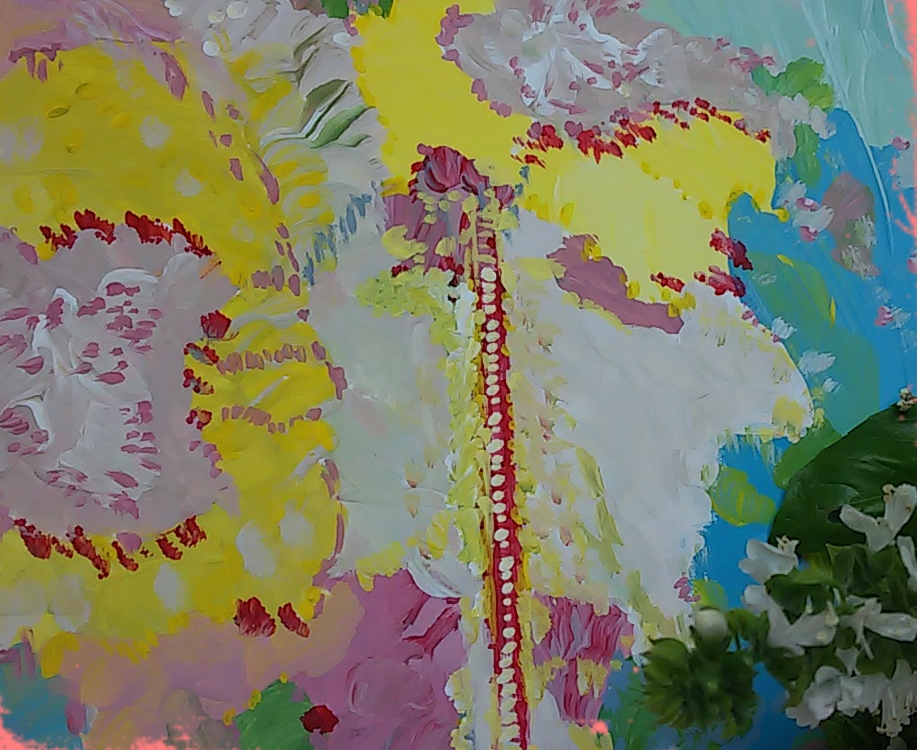
Below is part of a picture I recently painted, the first one in decades and before I figured out how to mix more nuanced colour, photographed in the wrong direction and accidentally, next to some basil.
 
Brush: Favourites by Egg9700 at DeviantART.

Doubt into Yellow

Here is a photo of flowers taken two days after I bought them in the market from an old lady vendor on her little stool, whose shaky hands produced my change in notes pre-folded. There was such distillation in her existence, such premeditation and simplicity that I long to see in myself. I did not recognise the yellow flowers as snapdragons, and asked their name to learn the local appellation, "little yawners". There is a great distance between a yawn and a dragon's roar (assuming dragons roar). I found myself either roaring or yawning last week, it seems I have to watch out when people start talking about education, which I see as a craft and by no means a product. I hear I will be hired again this year, which is excellent considering that my PhD dissertation has fallen into an administrative black hole and as such is yet undefended. I need to know how how to greet what we are told to see as uncertain with the zen attitude of the surfer. I used to spend hours reading about surfers, like Laird Hamilton who was raised on waves so, naturally, I might think, sought big waves. Surfers don't tend to be big on words but to watch them is to see a difference in humanity: many take the plunge, but not with equal grace. Laird surfs effortlessly, in sprezzatura, little yawner with the force of a dragon.
There is a big wave before us; we are told it is big especially by the media. Where it is not bureaucratised, it is ruled by the relative values not of sophistication, like Feyerabend's defense of 1950's China's adoption of the Yellow Emperor's Textbook of Internal Medicine ("Acupuncture, moxibustion, pulse diagnosis have led to new insights, new methods of treatment, new problems both for the Western and for the Chinese physician"), but of musical chairs where the chair one had been sitting on may suddenly be removed in the next round, if it is the volition of the games' master to remove that particular one. Whether you are an artist, a teacher, an entrepreneur, you will hear about plenty of uncertainties.
After reading a useful post by Enbrethilel I wondered about how, frankly, we might need to be wiped out before the questionning of what a healthy mind takes for granted can begin, and the words can rally forth. Her post was specifically about education, and cites a book by John Taylor Gatto in which he identifies a problem of our age as beginning, "when the young were assigned to consume, not to produce". I will posit here that part of what it takes to create (poiesis) is doubt.
A recent NYRB article on Koons explains, "where there is no doubt, there is no art." It is doubt that reduces one to the epistemology of one's ontology. This can be explained by Taoism: I found a page that does this quite well (it gives the gist): "Certitude evolves forth to DOUBT as it answers, yet DOUBT revolves back to certitude as it QUESTIONS; hence, answer within the DOUBT, yet QUESTION within the certitude." In this equation, one is just to "realise" the extremes, flow, and potential balance.


Before the Taoist's five elements theory, symbolised in five colours (black, green, red, white, yellow), there were only the two colours of yin and yang: black and white. The "Yellow Emperor" mentioned above is not only said to be the ancestor of the Chinese, dating to the third millennium BC, but is an important deity in Taoism and it was his tribe that practiced what we take as typical Chinese medicines like acupuncture. He is also said to have helped create the first Chinese calendar and his wife was said to have discovered silk: no small discovery (need one even mention the silk road). His tribe honoured the yellow earth and Yellow River, and that colour, of the five, is that which symbolises a stabilising energy, associated with rice which grows in the yellow earth and brings stability to mankind. It is also important to feng shui, which is based on the five elements theory that roughly correspond to the cosmos.
I am focusing on yellow as it is the colour one hopefully comes to, it is the centre of the bagua, if you have ever seen that octagonal trigram template used in feng shui. It is a reminder that one is to seek the balancing force; e.g., in times of increased activity, to seek a restful attitude.
The skilled surfer does not wobble and is not too stiff. To quote a page on Taoism, "REST within the activity suggests that we will feel better in all life’s activities if we bring a RESTFUL attitude to activity, or as the Tao Te Ching puts it, blunt the sharpness; untangle the knots; soften the glare;… and so on." Such is one story of the yawning snapdragons.


Background: Marie Claire Idees; Brush: Ewansim flower grunge at DeviantART.

Recognitions: Artistic, Disciplined

What if Plato really is the author of all of the epigrams that could be attributed to him?  If he wrote longingly over men, how is this to be reconciled with Plato's Socrates who in the Phaedrus argues against physical contact in the erastes/eromenos relationship (that of the lover/student).  The soul is to be loved above the body; what is more, the passions are to be bridled - this is a recurrent theme in Plato, albeit via Socrates, who is even more adamant on this point in Xenophon (e.g. Memorabilia 1.3.8-15).  The theme is revisited too in the Republic, where physical contact again denotes lack of restraint.  Thus we return to the epigrams, one of which in true Herrick fashion attempts to woo the beloved, but if rejected, harkens to the swift passing of beauty (CURFRAG.tlg-0059.7).  Of course, they may be spurious, but if they are his we are left to wonder about the distance between ideals and reality.  I find that when speaking to contemporaries about the "classics" one must explain that ideals are not so much destinations as they are direction ("true" North) for the coordinates we draw for the transit of our passing lives.
Which is not to say that some people aren't able to reach that ideal, or get very near to it.  So how much is one to try to reach it providing of course that one concedes to its existence (we admit it is contested)?  If some of the more mundane epigrams are really Plato's, one may see the discrepancy between ideal and practice, or at least a different emotional level in prose and poetry.
The possibilities are interesting, though I do not really see the epigrams as obviously Plato's.  He had his academy, the remains of which I will share photos of soon: such a position, to be in the public light at that level surely constrained him - or did he indulge in the mores of the time also as a means of assimilation?  Again, though, one really does not want to be party in work that seeks to "humanise" those humans who through gracious exercise really did reach another level which can look impossible to the uninitiated.
That said, and from where I am standing, I am interested in the crossroads between a throw-it-to-the-wind personality of soulfulness and the disciplined, analytical personality of what Prof. "Bob" Thurman called in one of his lectures scholastic spirituality (in the West, we remember that study was once the appendix to the monastery: sharing the same values of self-denial for service). 
I can see "Bob's" smile and although I cannot remember his answers, I think as I try to sort these thoughts out of Gadamer, and what he wrote about play.  Before embarking on that, I'd just like to say that today we may be conflicted about informal play since so much of what should be private ends up getting shared if not via social platforms then through other formal outlets.


Gadamer writes in The Relevance of the Beautiful (ed. Robert Bernasconi) that "play appears as a self-movement that does not pursue any particular end or purpose so much as movement as movement" and notes Aristotle described self-movement as the most fundamental characteristic of living beings (De anima 1.3 and 1.4.405b33-408a).  It is relevant that Aristotle is cited, because he, after all, is the one who defends, say, tragedy, whereas Plato bans it being showed, at least to just any public, in the Republic.  Aristotle seems more interested in the process of participation (think of On Poetry).  And Gadamer writes about tragedy and comedy: that in the traumatic experience of the tragic and liberating laughter of the comical, "a deep and disturbing encounter with ourselves, overcomes us. In this experience, any distinction between play and actuality, appearance and reality, is eliminated."
In other words, there is something mystical about the mirror that may be offered through art.  In Aristotle, it can transcend the borders of genre. To cite one of the spurious epigrams of Plato: "Lais offers this mirror to the Paphian because she has no wish to see herself as she is, and cannot see herself as she was." (CURFRAG.tlg-0059.11) 
What if we could see ourselves as we are, and we have changed, may be the next question.  Plato's Socrates in the Republic says, "when you have said a thing stand by it, or if you shift your ground change openly and don't try to deceive us" (345b). 
There is a risk in being wrong, in "the more anthropological dimension that bestows permanence" (Gadamer).  The permanence in the spurious epigram cited above is the vision of Aphrodite (referred to as Paphian, which increases the likelihood the epigram is not Plato's) portrayed in thankless pose.  Something about who we can be but don't want to be remembered as.  Something that philosophy warns us of, but the soulfulness of deep question drives one to its coordinates.
Maybe what I am saying is that for some of us, we need all the paintings, the music, the poems, to first fill us like mistakes before we realise the problem inherent in some destinations.  At the same time, we cannot be liberated by renouncing memory, neither ours nor that precious reserve of others' experience.


Gadamer writes:
the penetrating gaze of Mnemosyne, the muse who maintains and retains, marks us out.  It was one of the basic intentions of my exposition to show that in our relationship with the world and in all our creative labors - forming or cooperating in the play of form as the case may be - our accomplishment lies in retaining what threatens to pass away.
But he also explains that it is the symbolic that "meaningfully addresses us in the play of form" that comes together in the concrete work:  "every act of recognition of something has already been liberated from our first contingent apprehension of it and is then raised into ideality."
Recognition can stop the flow of time by bringing out something of permanence.  But how much trial and error is necessary to figure out the symbols worthy of the sacrifice of time: how many narratives chatter on without consequence in the mind of the every-day man?  Surely it is art that helps this recognition to occur, by exposing self, in the process of discovery, to both that which is worthy of Mnemosyne and that which is not.  It is also recognition that ties art to study, to my mind at least.  I want both of them to solve the puzzle of my life and existence.
Part of this experience cannot be answered by idea or ideal alone because those coordinates are there to be guiding a vessel.  That vessel, if it comes to pursue φιλοσοφία, may contain wanting poems or outbursts of passion.


 Brush en lieu of watermark: Ewansim's tape at DeviantART.

Book of Experience

One of the gems from the second-to-last edition of On the Shoulders of Giants (which will now migrate to a weekly post here) was the discovery of a blog called Conciatore written by Paul Engle about 17th century glass maker Antonio Neri, who was, as per the blog title, a "specialist in alchemy who formulated glass from raw materials".
The most recent post, a very interesting guest post by Maria Grazzi, is about how Neri was plagiarised by a Jesuit scientist - but the part I want to respond to are her describing the "'scientific' mindset" as the study of the "book of Nature" and knowledge being acquired "with the practice of many experiences" (emphasis added).
Pierre Hadot in The Veil of Isis reads the book of Nature as follows: "Bernard Silvester reserves the word integumentum to designate myths intended, as in Plato's Timaeus, to explain a natural phenomenon (they reveal a true meaning hidden beneath a fabulous story), as opposed to allegoria, which is proper to the explication of biblical texts (it reveals a new meaning in a veridical historical narration). We find this distinction again in Dante. It corresponds to an opposition between the two books written by God, the Bible and Nature, both of which can be deciphered only if one uses an allegorical exegesis, which, in the case of the Bible, refers to sacred texts and, in the case of Nature, to myths. This Nature, we must recall, was conceived in the Middle Ages as a power subordinate to God but enjoying a certain autonomy."
Hadot later notes the resurgence of viewing Nature as a language or code, signature, hieroglyph and book in the seventeenth and also eighteenth centuries (the latter in Kant, Hamann, Goethe).
There are precedents of viewing nature as a book, like in the Pythagorean view of nature as being written in the language of mathematics. One might also observe that Homer's description of Achilles' shield fabricates the world as a reduced symbolic model.
While I understand combining the study of the book of nature with knowledge of such gained through experience to describe 'science', I wonder how many scientists actually fit this simplified model.
On Engle's blog itself, we read in From Beads to Belief Reprise that not only did Neri read Psalms by way of keeping time for his extraction of colours and dying but that he made glass beads that were not only material but of spiritual value: "they served as sequential placeholders in prayer, as objects made by man in the fashion of natural stones or gems, which were physically held and invested with hopes and dreams".
Similarly, and to choose an example of a later scientist whose narrative also addresses allegoria and integumentum,  J. C. Maxwell wrote, "We may use our knowledge of such truths for purposes of deduction, but we have no data for speculating as to their origin." This complies with Engle's observation of Neri in Beads: "At first blush, it might seem that religion would be at odds with alchemy and glassmaking. In reality, practical elements of Neri's religious life integrate seamlessly with his work at the furnace and in the laboratory."


In another context, Maxwell wrote: "I would be very sorry if an interpretation founded as a most conjectural scientific hypothesis were to get fastened to the text in Genesis, even if by doing so it got rid of the old statement of the commentators which has long ceased to be intelligible. The rate of change of scientific hypothesis is naturally much more rapid than that of Biblical interpretation, so that if an interpretation is founded on such an hypothesis, it may help to keep the hypothesis above ground long after it ought to be buried and forgotten."
That the distinction between the 'two books' may be seamless can be seen by Maxwell explaining, "and I think Christians whose minds are scientific are bound to study science that their view of the glory of God may be as extensive as their being is capable of. But I think that the results which each man arrives at in his attempts to harmonise his science with his Christianity ought not to be regarded as having any significance except to the man himself and to him only for a time, and should not receive the stamp of a society."
To this very day, there are bishops ready to cite science for change or scientisimists who are ready to say that scientists cannot possibly have faith if they are to be successful.
What Maxwell writes might also be considered as advice against the trend of scientistic social interpration. I was thinking about that when I read Engle's post on Turquoise where Neri stresses the importance of experience when making the "sky blue" of turquoise: this privileging of science applies only to this very particular work in the laboratory. It does not apply to a life figured out through experience only.  Ἰωάννης τῆς Κλίμακος writes about such an approach to spiritual progress, saying this is a long (possibly uncertain) path, as opposed to learning via υπακοή - which I would describe as the leap of love, where one is devoted to the person, place, instruction not so much for what it is, but as a form of anchor to a type of flightiness that might otherwise get the better of one. (Maybe this is not an accurate description.)
Viewed as a book or books, the natural life of man contains so many rich stories. To return to Engle's blog, we learn of the 'evil spirits' of cobalt (kobald - this is particularly amusing if you are learning German here), which were the toxic fumes released in its making; the insects used in crimson dyes and for medicinal purposes from the Mediterranean and later from Mexico; the "as it is" in perspective painting and in science; trade agreements blocking access to raw materials - know-how unto itself may not always be enough, though the blog, being about alchemy, frequently stresses the rarity or non-existence of published know-how. But today, Conciatore, the blog about a book in part about the book of Nature, is to become a book. We say well done, and wonderful guest contribution by Grazzi.


Book: Midwest Modern. Brush: Ewansim tape at deviantART.

At the Cost of Sleeplessness

I think of Kierkegaard's sleepless man (in Fear and Trembling), the one who is hungering for answers yet is at least twice misled by the words of men who speak without knowing what they are talking about: sleeping comfortably, fearing to awaken the deep choices within man yet ridiculously proffering cheap editions of the edifying. This idea of the sleepless man ties into my recent reading of "The Ring of Gyges" (The Economy of Literature) by Marc Shell (via) addressing the value of philosophy and also responds to the sleeplessness one may suffer over the wish to learn that may be misunderstood by family.
According to Shell's reading of the myth of the ring of Gyges and of Plato, wage-earning is the tyrant's replacement for philosophy. The tyrant lacks the necessary intelligence to see the ἰδέη - though, as the perfect spy, as we shall see, he can try to kill it. According to Plato, the only currency should be wisdom and the goal of thought is to make the tyrant visible - remaining invisible through hiding himself so people think him better than he is and by making people always visible to him by spying on them (hence being the perfect spy).
When I think of the tyrant in Shell's essay, I consider both the mundanity of his behaviour (e.g. the vanity of worrying over how he is perceived and the mobbing of gossip) as well as the work done by him to cover up true meaning. This corresponds to one of Kierkegaard's thoughts in Purity of Heart is to Will One Thing (ch. 10): "it lies close enough to us even though frivolity and sensuousness, worldly cleverness and godlessness wish to remain ignorant of it".


Shell also emphasizes the many references in Plato to men who divide the whole into parts like coin changers. The metaphor can be applied to what is happening today in academe. In an interview from last year, East Asian scholar Wm Theodore de Bary said: " You have a Global Core and what is, in effect, a distribution requirement that goes off in any direction you want. It doesn’t bring people together on 'core' issues. The only way I could suggest they do it is to take the courses we designed for the Core". Describing the whole being divided into parts as the poverty of moneylenders is a rich metaphor. But if we have learned anything here, we know that the desired currency is above the politics of the tyrant and the monetary greed of the sophist. That is not just a sentence but a reality for those who lose sleep over criticism that their pay does not match their credentials.
We may think of Kierkegaard's "most precious thing" (from Fear and Trembling) that again is not demonstrated by material value but the ethical responsibility and fear of a father: it is most precious precisely because of responsibility and fear. The precious is valuable only where it is metaphorically linked to morals and the agony of standing up for them. (Kierkegaard, in his retelling of the parable of Abraham, suggests that people should be given the option to turn back before making the sacrifice: he also stresses the difference between the hero and the poet, but I will save that for perhaps another time.)
The metaphor also translates into the gold of globalism that cultures "exchange" without necessarily understanding each other better. To quote Bary again, "global centers contribute to the undergraduate learning process. Students go out to commercial centers in the rest of the world, and all they get exposed to is commercialism. They’re not going to learn the culture of those countries—they’ll take what’s immediately available in the current culture. It’s just academic tourism, and it doesn’t add up to anything."
To go outside of the commercial center, one runs the risk of being criticised by family. To remain in said culture warrants even more criticism and sleeplessness - though one has a chance of reaching some kind of core, the core of a culture, the core of ἰδέη - because if there is one thing one is not, it is a tyrant. And while one may "commit to the Eternal" to deal with the pain, as Kierkegaard writes in Purity, "the wish continues to pain" for "in the wish, the wound is kept open, in order that the Eternal may heal." The questioning never ceases where the whole of life teaches but can one get used to it or does one turn back.


Between Divergence and the Focal Point

So many times I think to myself that I will stop writing. This occurs to me when I feel the thoughts are too revealing; when readership halves as it is wont to do; when I consider the topics addressed here so broad as to represent the least responsible form of dilettantism. Sometimes, I am jealous of the person who can say: I am ___; I do ___. Ah! The human life, this three-footed receptacle (the pair of legs, eyes, and proverbial wings). I read a beautiful piece yesterday about a shopkeeper who on seeing a woman's interest in a Delphic tripod, brought it outside, filled it with bay leaves, lit coals, and sloshed it with ouzo (scroll down; but the tripod was also sat on?). To reenact is one way to have a hand in the past. Like handling antiques, and the invariable frisson of all the piece has been exposed to, craftsmen, owners, voices, settings. Like if one hands grains to Streptopelia capicolae, every time one hears their call, one may feel a nearness to the species, as if one enters their song through proximity and offering.
And perhaps this is the point of the writing, to be released from the prison of petty worries and give oneself over into these various melodies that have existed for centuries (even the thoughtful unlearned may encounter :  truth, like inventions, may be in the air as much as in the mind). Such leitmotifs become so much more tangible if written, not only thought. 
Helps explains, "most persons, if they have but placed one brick in a building, are interested in the progress". We are called to participate: the tripod beckons to be used, like petroglyph spirals and staircases beckon to enhance the vocabulary of dreams. It is here where the human arts are to be developed if there is to be medicine for the soul. In this way, we remember that our thinking is weak without symbols so we return to the discursive idea-talismans of the past. They gather within themselves more than one perspective yet form a focal point for thought. In fact, it is the awareness of a history, e.g. of the symbol, one aims to report correctly that refines and defines dispersed thought. Doubt of one's conclusions refines and defines.


In Hyde's introduction to Trickster, he references how Italo Calvino "meditates on Hermes and Mercury, Europe's old quick-witted gods (the ones with wings on their shoes, the ones whose statues still adorn train depots), and Calvino confesses that he always looked to their speed with the jealous longing of a more methodical craftsman. 'I am a Saturn who dreams of being a Mercury' ... Saturn is the slow worker, the one who can build a coin collection and label all the envelopes in a near script ... he needs Mercurial insight to give him something delicious to work on". Here, methodical diligence is contemplated together with the dispersal of dreams. The musing and the symbol seem lost to us today, at least in the mainstream. Harry Eyres' Slow Lane column this weekend considers how the contemporary man is more concerned with relationships and the act of passion than the far more difficult love. 
The symbol and the leitmotif are enriched by the many viewpoints and paradoxes that are borne by those who have peered into their selves and noticed the belletristic cast of characters the individual may hold at a given time. The wisened granny. The jester.
"That’s when I was learning how to actually be an adult in this fucked up place," says the man after the wandering divergence of the experience of youth, which "backgrounds the writing that sticks". With any luck, we enter the stream of the continuing song of man. The adult, refined and defined through the practice of this writing, if only as a collection of focused but divergent symbols, made grander through comparison and analogy, offering the smoke from the tripod up to the heavens, with a hand in eternity that means something determinate. With any luck, our lives and thoughts are clarified into that charm bracelet, the charms of which might resonate into other people's lives whose lives have already resonated into our own.


Words from Fennel

It has been a holiday season of spices, I even perused the market looking for a better mortar and pestle; among the brass handiwork was a stall of postcards, some from the 1920's, carefully arranged beneath a magnificent cigar box, causing me to wonder at the vendor. Those travellers' words, in such neat little stacks at such an inconspicuous stall, for whom?
I remember long ago seeking out the shell of a 19th century spice store in Ravenna; there it was, it, Dante's grave, and the flooded church crypt, the Basilica di San Francesco, tied together in my imagination, for it was the waters that brought the spices across such long distances, navigated by the pattern of the Galla Placidian sky. Who would not also think, in connection with sea and the trading of spices, also of Elizabeth I, the gathering together of aromas like so many tesserae.
I have been making masala chai and harissa, as if these spices could calm the sea in the bones. I think back to Gloriana's explorers, looking for passages around continents in all that darkness of the unknown. Perhaps there is no need for the symbol of our shared horizon when, as Rebecca West once wrote, today the laziest person has but to recline into the already established grooves of transport. Other types of travellers, though, may take the line of Io in Prometheus Bound: "My far-roaming wanderings have taught me enough." (PB575)
She, as Prometheus, is εσμώτης - chained, fettered, considering herself to be bound to misery. In fact the play could be seen as commentary on how man's dreams and imagined futures blind him to the present and bodily restraint: the characters are bound despite their machinations. The Chorus says to Prometheus: "Sweet it is to pass all the length of life amid confident hopes, feeding the heart in glad festivities. But I shudder [540] as I look on you, racked by infinite tortures. ... Did you not see the helpless infirmity, no better than a dream, in which the blind [550] generation of men is shackled?" They reprimand him for his lack of humility - and he, he is not allowed to die, having transgressed normal bodily constraint (PB742).
Io's misery, too, was beset by visions, dreams, and aggravated by the oracle: ἧκον δ᾽ ἀναγγέλλοντες αἰολοστόμους χρησμοὺς ἀσήμους δυσκρίτως τ᾽ εἰρημένους (661-2) "oracles, riddling, obscure, darkly worded" (literally: an oracle that is unintelligible, hard to interpret, shifting in words).
The answer of an oracle, χρησμός, is related to the proclamation of the gods in the oracle, χράω, a word with many other meanings, including to furnish to the senses. Gadamer writes that the oracle proclaims a multiplicity of meanings to be interpreted (RB69). As opposed to this is the emphasis on speech that is truthful and telling plainly in simple language without riddles (PB640,609).


But even a μῦθος is a saying: a saying that possesses reality only through its being said (RB70). We are also wont to remember the opening to the Theogony: the Muses tell as much truth as they do lies.
Io is seeking the truth. Alone, she "cannot discern how to escape" her sufferings (PB575). She begs Prometheus to tell him her future but he declines, not wanting to crush her spirit. (PB609) So she implores him again after telling her tale and revealing how much of it was riddled (see above). "Do not, from pity, seek [685] to soothe me with untrue words; for I consider false words to be the foulest sickness." The Chorus replies: "never, did I dream that words so strange would greet my ears; [690] or that sufferings so grievous to look upon, yes, and so grievous to endure, a tale of outrage, would strike my soul". (PB697)
It is at this point (PB 696) that Prometheus begins to talk like a guidebook. But as he talks, he does not tell the simple truth Io wishes to hear, but a "prophecy," that is "not easy to understand" - i.e., οὐκέτ᾽ εὐξύμβλητος ἡ χρησμῳδία (literally: no longer easy to divine/a good omen [is your] answer of an oracle). He calls his words "tales" λόγοιν. He then continues to speak in riddles, offering her an account that may be hers or that of his deliverer.
Gadamer writes that something may be intimated but not intended. "Interpretation seems to be a genuine determination of existence rather than an activity or an intention ... The meaning of the oracle in this sort of tragedy lies in the fact that the hero provides an exemplary illustration of the ambiguities of fate that hang over ever one of us. As human beings, we are essentially caught up in the attempt to interpret the meaning of this ambiguity." (RB71)
Io cries that she has learned enough from her travels, and wishes for them to end. But such was not her fate, caught between the simple speech she longs for and the words of others. Perhaps a life is made up of as many such tesserae: some of our own making, and some of context.
But what of the spices, you ask? Maybe you know. Prometheus used a stalk from a fennel plant to steal fire from the gods. Fennel is used in 五香粉 which came to the West via the diaspora. There are many sorts of travellers, not all just following grooves. Perhaps the danger is not in the travelling but the will of the traveller. As the Chorus says, may Zeus' power never be set in conflict with one's will (PB 526). If one could but go with the flow, or live as the guest-friend.


Magazine. Font: Deftone Stylus.

Tzitzikas

"The forests were cleared to afford a prospect for observing whence came the auspices of the eagles, who fly higher than all other birds," writes Vico in New Science. He notes the architectural terminology that connects birds with pediments and battlements. Yet birds belong to the poetic age, "wings which the Greeks in their fables attached to all the physical objects signifying the heroic constitutions" along with barbarians in plumed helmets and Indians adorned with feathers. I don't remember whose idea it was as I come from a rather cycnical family, but I remember releasing my own birds as a child at the Wat Pho Temple. There is something to the bird.
And insects. It has been pointed out that both Callimachus in his Aitia prologue and Plato in the Phaedrus identify themselves with the cicada. In the latter work, Socrates and Phaedrus speak beneath a tree of cicadas (258e) Socrates posits are those who are older than the Muses (the musical Ligyans, λίγειαι Λιγύων 237a) and can bestow their wisdom from the Muses on men (259b-d). It is the listening to the music of the Muse-locusts that brings the gift of speaking. Except it is not any kind of listening: to merely be lulled by their voices they would fall asleep: to receive their message they must not be "moved by the charm of their Siren voices." (259a)
Both Callimachus and Plato invoke Calliope and strive to make the “sweetest” music, namely that of divine thought and philosophy. Those who are dear to and love the Muses are brought signs by them.
Imaginative Callimachus, too, discerns between sounds, not between being lulled and listening, but between the bray of the ass and song of cicada, for he wants to: "Sing living on dew drops, free sustenance from divine air" - like Plato's locust intermediaries who report on those "concerned with heaven ... whose music is sweetest". Passing their lives in philosophy (or song like C.).
This is a timeless answer to Vico's 3 ages, which may be the myth for the modern man: no monsters, but a new rewriting of history with more literal metaphors that the scientific man can understand. Myths are discarded as childish. Martial criticises Callimachus, "Here you will not find Centaurs nor Gorgons and Harpies ... But you, Mamurra ... you should read the Aitia of Callimachus." As Martial thought Callimachus the best Greek epigrammatist, he was really arguing for Mamurra to focus on things that may be seen in Rome: instead of thinking of the monsters of myth, observe the monsters that may be seen walking the city streets. Martial's dedications to the gods change with this shift in literary mode. The modern myth must draw from the streets. Or, man becomes his own myth in an allegory teaching moderation and measure. "And here we  have a luminous proof of the fact that the first fables were histories"


To see how man can become his own myth, we may note how Socrates retells the story of the λίγειαι, the Muse-locusts: "these locusts were once men, before the birth of the Muses, and when the Muses were born and song appeared, some of the men were so overcome with delight [259c] that they sang ... forgetting food and drink, until at last unconsciously they died. From them the locust tribe afterwards arose, and they have this gift from the Muses, that from the time of their birth they need no sustenance, but sing continually, without food or drink, until they die" - just like Callimachus' "sing living on dew drops".
But another story could be told. That of half the Ligyans standing aside during battle and singing. Or the Ligurian who helped Marius. What is the point of the story? The end, as Gadamer has shown about history, determines the beginning we perceive - and what we perceive, how we tell it.
By extension, flying, singing creatures, crickets, may be part fulfillment of New Science if they point to the golden mean.
In ancient Greece, crickets were kept "in little houses like singing birds in the apartments of women" for their song; it was fashionable to wear a golden cricket in the hair. Socrates connects them to the Ligyan-muses - but the Swan is connected to the people of Ligya, too, having brought from there "its dying song which was afterwards derided as a fable to the well  known seats of the god ... and at Delphi". There is something to the bird. And insects.
The poetry of the cicada may be kept, if we are not lulled to sleep by it. Just like Vico warns that, "Learned fools[fall] to ... false eloquence, ready to uphold either ... sides of a case indifferently ... malicious wits [turn] them into beasts made ... inhuman by the barbarism of reflection ... a base savagery, under soft words and embraces, plots against the life and fortune of friends". This calls to mind Dalrymple's contemporary observations that moral relativism can be the deception of an egotistical mind to mute conscience, and that the entitlement of rights replace the far deeper attitude of gratitude and mutual responsibility. Tzitzikas - the more difficult thing. To make sacrifices: staying awake on hot afternoons, hearing the conscience, being moved by the indebtment to others. Making the "sweetest" music administered to the needs of the day.


Rings

There is the permanence of the rings worn on the necks of the doves that occasionally visit my windowsill. I have watched the ring grow into one of those smaller creatures, apparently they are not born with that ornament, nor are we to marriage. That institution is wrecked with emotional malice by so many; that wonderful vessel meant to keep a pair intact to the end of life.
Perhaps not everyone needs that vessel, one imagines the vagrant bards of yesteryear who thrived on that particular lack of convention, but what of those who are shipwrecked and lost, like Crusoes without islands and without trust. Trust takes an age to earn but is so quick to be lost. If there is not enough love, if the people peer into each other ready to pull out all the ugly laundry of which there is always an abundance, the thing ends. Vendettas begin and one remembers Plato's wish for men to be shielded from the drama in poetry - if they really must expose themselves to themes of jealousy and rage and so on, they ought at least to be mature enough not to imitate, and even then must perform a solemn sacrifice first.
I am beginning to think that it is precisely the lack of ceremony that may affect the mindset before it enters into activity. No special clothes worn to the work place means too much comfort and sloppy manners. Ceremony - a private kind, a secret shared between one person and themselves - is the almost ubiquitous tattoo; it is not in the marriage, officiated by any person with an internet diploma.
So, two otherwise intelligent human beings may enter into the lifetime schlep not out of deep bonds of respect so much as a knot of other reasons like convenience, crush, confusion. They may soon see the ring as a little metal noose and they gag. What began as a clueless waltz often leads such victims to the halted opera of extremes, claiming they do not need love, marriage is a sham, humankind is hopeless.
But the purpose of union, of which friendship serves the same in miniature, in its own separate bonsai plot, is preservation of self and the other. To turn the other's face when life brings out their less handsome side. Oh, to flee such situations - we would, but their horrible power lurks in the fact that we cannot see them coming. Another person can be our reminder that time resides not in our minds or emotions by bringing us out of ourselves to face a bigger picture; to have a person outside one's self, surely this is something quite mysterious.


The simple ring is much; it is the echo of the crown, the one that is earned through noble gesture, it is the shape of an imagining of eternity, it warns one to go around as one wishes to come around. It may be a thing, but things were never meant to be disposed of. I remember many decades ago in my geography class hearing of one Western country with its piles and piles of trash: how could that be a quotient of greatness, I wondered. Why on earth would something be made if it is not meant to be kept and used to the very end? Surely such a mentality does not help people understand the worth of existence.
There emerges a kind of craziness to the effect: if it isn't pleasing you, toss or swop it. How many unstable characters wonder feverishly to themselves if they are getting all they think they ought? And toss it all, just in case. Or, if not toss it, disrespect it through unhappiness. Sometimes, enough is there - except perhaps enough will to make things work. But why such caprice, one might ask. Sometimes when two such people separate, they each go down their own version of the self-destructive path. They had been perfect for each other, and now they are alone and worse than ever.
Perhaps worse than that is the constant stream of verbal second-guessing. Some people's word-actions seem bent to destroy those around them, these are the creatures that seem most eager to burrow into marriage, most eager to play the hypocrite. Many are the forms of sickness never accurately responded to in the culture of disposable things, illustrated here in the prescribed tablet. One may sit and wonder at such things as one once wrote observations of adults into legal pads, at the dawn of adolescence, not trying to be smart (for knowing the theory does not exempt one from practice) but hoping to enter that helpful narrative stream one once found in books. Writing the book that is needed by oneself.
To think of the ring, one wishes for it to be idealised - as that crown that may be worn at the beginning but is only deserved at the end, if good speech and action outweighs all else. There have been marriages borne by just one of the two; the one bearing the acid of the other, always with grace, always with that kind humour towards others that is only earned under harsh circumstances. Such people are to be admired, but perhaps they had already known love from one time before in their lives.  
To find reciprocity in life, already symbolised in the back-and-forth of the circle, one would surely choose to contain that bond. Not contain it in a vessel, which measures with its grooves, but in a perfect abstract shape.


Traded In

"Do you think Poirot concerns himself with mere thingness?" Poirot rebukes Hastings for suggesting he replace his starched collars with the more fashionable, turned-down collar. The line also evokes Jeeves' criticism of Bertie's penchant for trend, once taking the form of a ridiculous hat. Such ridiculous fashion preceded the grim reality of having to sell off the manor, bit by bit, to any person who had the money to buy it, as illustrated by the television show, To the Manor Born. There are things, and there are things. In Poirot, we have a character who avails himself of city things: the dainty shoes not meant for walking being perhaps the most significant. The city is: short walking distances, cabs, paved surfaces, no sullying mud or insect. The city is that convenience of shops and services, all in one place. The manor, more complicated.
There are things, and then there is their worth. I don't know that I would have known this had I not had my Cornwelian head of house who arraigned us if we were to discard so much as a scrap of paper before it was fully used. I was reminded of that - to not speak of habits that become unthought of - when I saw a documentary on how aluminum foil is made. To watch a thick metal sheet become the thin product that so many so readily discard is to gain vertigo. Not to mention clothes that are practically disposable, made in slavish conditions: so much could be done without.
But the lack of uniform (which applies to interiors) leaves people to their own devices. When I was schooled in France ions ago, there were three dominant styles for the fairer sex: pearls and pencil skirts; checked blouses and black jeans; and Morgan (vituperously derided by some). Today, people who have no sense for the uniform may get lost - Berties in ridiculous trousers. Too much choice becomes a curse. Poirot, though a man of his times, does not concern himself with mere thingness. He has chosen his fashion.


The fourth category of fashion in France was made up by the people, including residents from Nordic countries, who would buy used clothes where it was sold by the kilo. There, they acquired worn-in jeans, softened leather jackets - so many of the things that remain fashionable to this day. Glorified puces. But this is the part of fashion that ages slowly, seeking objects that can wear.
It is at odds with the person who does not know what or who he is, the Berties of the world seeking the mild rebellion that is made manifest precisely in things, in the disjointed language of the surreal parroted by advertising. Never mind that such forms are but mere aping, the aping of the taste that emerges when one feels collectively divorced from the world.
Like the factory protagonist described in this wonderful podcast (click where it says, "On peut la retrouver ici" if the embedded link is faulty). A factory worker feels he cannot express himself due to the automatic repetition of his movements. Words stolen by inhuman processeses, even though, as one of the podcast speakers points out, the machines were modelled after man: if they work better than man, it is because they are performing man's actions except faster, more accurately. Machines, though, require man's surveillance. Which, I might add, is so different from the work and looking after the field: the notion of responsibility shifts into something much more worldly, involving - freely - the elements, allowing for factors that cannot always be controlled.
The podcast makes another point: we still reach machines through language (controls on mobile phones; commands in programming). It would seem that language is the field the mute should seek to re-appropriate - to reconnect the drives silenced in the factory worker ever less capable of describing the feelings of his interior life.
The surrealist rebellion is the rupture of speech, now, everyone is dying their hair in the style of the urban warrior, appropriating African war symbols, no longer in touch with their native tongue.
We are told the world has been conquered ("globalism") so the travelling dreamers are silent - where they exist, their existence is disbelieved, as if they were a myth.


I turn to this excerpt from Saki (H.H. Munro) via: "It was the unledgered wanderer, the careless-hearted seafarer, the aimless outcast, who opened up new trade routes, tapped new markets, brought home samples or cargoes of new edibles and unknown condiments. It was they who brought the glamour and romance to the threshold of business life, where it was promptly reduced to pounds, shillings and pence".
I saw that world, I can attest to its existence. As I said, it still exists, but its voice is silenced by the mechanical news, which is now the dominant voice of the age, not the travellers' narratives of eccentrics, as was the case in the day of Jim Thompson. Society does not look to those encyclopedic personalities who may have been wrong in much, but were also signs of the magnitude of the single mind. They are too complex for us, it would seem. Who has the time to sort through them and discern? It is easier to analyse the processes, but in doing so, we lose the man.
So it happens that to depict a glass vessel, we see a glass vessel, and not a way of looking. Is this because in a world of language being reduced to commands, we take things too literally? Instead of seeing a uniform as restriction, it is freedom from choice - like what a wonderful friend from the past said about marriage: I love my marriage, because it made that choice of who to be with for me, I no longer have to worry about that.  To run from uniform is to end up in a uniform made by others, woe to the nonconformist who does not conform with nonconformity (this was a phrase in Bierce's Dictionary as far as I remember).
From speech to things to (dis)ordered drives. We have moved a long way's away from Auden's line (via): "the happy eachness of things". The reverence has been lost, some feel violated by these things, perhaps even the rush for thingness that Poirot so scorned. But to meditate, again, upon the shirt, this soft cloth woven of fibres at the perpendicular of warp and weave, eyed with buttons for easy donning, enveloping us in warmth, even making us look smart - surely this is a marvel. If that white blouse is too uniform for some, one might wonder why they wish their imagination to be stuck already on the basics. For the white blouse itself emerged through the uniform, because it is part of that uniform, the one that seeks to liberate from the perpetuum mobile, so aptly illustrated by the factory.


Book in background. Box brush. Postcard bursh: Lauren Harrison.